Following in Bush's footsteps of decidedly less-than-erudite private diagnoses of current international affairs becoming public, the UK Deputy Prime Minister, John Prescott, is reported in today's Independent as saying to a group of Labour MPs that Bush's Middle-East policy has been "crap". Not a treacherous microphone this time, but rather a talkative MP, that has brought this gem of insightful analysis to our attention.
The story is that Prescott insists that he only went along with the war in Iraq because of US assurances that the road map to peace between Israel and Palestine would be resurrected and enforced; and it is the failure of the Bush administration in this regard that apparently aroused his succinct condemnation. Prescott has not gone out of his way to distance himself from the comments, insisting only that "this is an inaccurate report of a private conversation and it is not my view".
This is hardly surprising. Much like his celebrated punching of a voter during the 2001 election campaign, this latest "indiscretion" is unlikely to do him any real harm; quite the oppositie, in fact, at a time when more and more Labour MPs - including Blair loyalists - are becoming more and more uneasy about the Government's handling of the Middle East: not only in terms of the increasingly-disastrous Iraq adventure, but also with Blair's recent refusal to condemn Israeli actions against Hezbollah in Lebannon as disproportionate or illegal.
The Guardian has an interesting comment piece on Prescott's apparent outburst - or, perhaps more accurately, on the Independent's overwhelmingly positive reporting of it - pointing out that the editor of the latter paper is both a close friend and official biographer of the Deputy Prime Minister; making it unlikely that, despite his half-hearted denial, it would have been front page news, in that paper at least, without Prescott's blessing. It may even, one suspects, have been completely orchestrated from the start.
And thus the media/politician game of bluff and double bluff continues, even if it is being played out to an increasingly sceptical, not to mention downright bored, public....
Thursday, August 17, 2006
Sunday, August 13, 2006
An Englishmen in Nazareth
I think the piece below is really worth reading. A rather balanced, yet firm, account of what it means to be an isolated minority in Britain. This reminds me that Europe is failing everywhere the test of integration of its rather large islamic community.
From High Wycombe to Nazareth: How I Found Myself with the Islamic Fascists; here's the source.
By JONATHAN COOK
August 11, 2006
Counterpunch
It occurred to me as I watched the story unfolding on my TV of a suspected plot by a group of at least 20 British Muslims to blow up planes between the UK and America that the course of my life and that of the alleged "terrorists" may have run in parallel in more ways than one.
Like a number of them, I am originally from High Wycombe, one of the non-descript commuter towns that ring London. As aerial shots wheeled above the tiled roof of a semi-detached house there, I briefly thought I was looking at my mother's home.
But doubtless my and their lives have diverged in numerous ways. According to news reports, the suspects are probably Pakistani, a large "immigrant" community that has settled in many corners of Britain, including High Wycombe and Birmingham, a grey metropolis in the country's centre where at least some of the arrested men are believed to have been born.
Britain's complacent satisfaction with its multi-culturalism and tolerance ignores the facts that Pakistanis and other ethnic minorities mostly live in their own segregated spaces on the margins of British life. "Native" Britons like me -- the white ones -- generally assume that is out of choice: "They stick to their own kind". Many of us rarely come into contact with a Pakistani unless he is serving us what we call "Indian food" or selling us a packet of cigarettes in a corner shop.
So, even though we may have been neighbours of a sort in High Wycombe, my life and theirs probably had few points of contact.
But paradoxically, that changed, I think, five years ago when I left Britain. I moved to Nazareth in Israel, an Arab -- Muslim and Christian -- community on the very margins of the self-declared Jewish state. In the ghetto of Nazareth, I rarely meet Israeli Jews unless I venture out for work or I find myself sitting next to them in a local restaurant as they order hummus from an Arab waiter, just as I once asked for a madras curry in High Wycombe. When Israeli Jews briefly visit the ghetto, I suddenly realise how much, by living here, I have become an Arab by default.
Living on the margins of any society is an alienating experience that few who are rooted in the heartland of the consensus can ever hope to understand. Such alienation can easily deepen into something less passive, far more destructive, when you find yourself not only marginalised but your loyalty, rationality, even your sanity, called into question.
As we approach the fifth official anniversary of the "war on terror", the foiled UK "terror plot" has neatly provided George W Bush, the "leader of the free world", with a chance to remind us of our fight against the "Islamic fascists". But what if the war on terror is not really about separating the good guys from the bad guys, but about deciding what a good guy can be allowed to say and think?
What if the "Islamic fascism" President Bush warns us of is not just the terrorism associated with Osama bin Laden and his elusive al-Qaeda network but a set of views that many Arabs, Muslims and Pakistanis -- even the odd humanist -- consider normal, even enlightened? What if the war on "Islamic fascism" is less about fighting terrorism and more about silencing those who dissent from the West's endless wars against the Middle East?
At some point, I suspect, I joined the Islamic fascists without my even noticing. Were my name different, my skin colour different, my religion different, I might feel a lot more threatened by that realisation.
How would Homeland Security judge me if I stepped off a plane in the US tomorrow and told officials not only that I am appalled by the humanitarian crises in Lebanon and Gaza but also that I do not believe the war on terror should be directed against either the Lebanese or the Palestinians? How would they respond if, further, I described as nonsense the idea that Hizbullah or the political leaders of Hamas are "terrorists"?
I have my reasons, good ones I think, but would anyone take them seriously? What would the officials make of my argument that, before Israel's war on Lebanon, no one could point to a single terrorist incident Hizbullah had been responsible for in at least a decade? Would the authorities appreciate my comment that a terrorist organisation that doesn't do terrorism is a chimera, a figment of the President's imagination?
Equally, what would they make of my belief that Hizbullah does not want to wipe Israel off the map? Would they find me convincing if I told them that Israel, not Hizbulalh, is the aggressor in the conflict: that following Israel's supposed withdrawal from south Lebanon in 2000, Lebanon experienced barely a day of peace from the terrifying sonic booms of Israeli war planes violating the country's airspace?
Would they understand as I explained that Hizbullah had acted with restraint for those six years, stockpiling its weapons for the day it knew was coming, when Israel would no longer be satisfied with overflights and its appetite for conquest and subjugation would return? Would the officials doubt their own assumptions as I told them that during this war Hizbullah's rockets have been a response to Israeli provocations, that they are fired in return for Israel's devastating and indiscriminate bombardment of Lebanon?
And what would they say if I claimed that this war is not really about Lebanon, or even Hizbullah, but part of a wider US and Israeli campaign to isolate and pre-emptively attack Iran?
Thank God, my skin is fair, my name is unmistakenly English, and I know how to spell the word "atheist". Chances are when Homeland Security comes looking for suspects, no one will search for me or be interested -- not yet, at least -- in my views on Hassan Nasrallah or the democratic election of a Hamas government for the Palestinians.
My friends in Nazareth, and those Pakistani neighbours I never knew in High Wycombe, are less fortunate. They must keep their views hidden and swallow their anger as they see (because their media, unlike ours, show the reality) what US-made weapons fired by American and Israeli soldiers can do to the fragile human body, how quickly skin burns in an explosion, how easily a child's skull is crushed under rubble, how fast the body drains of blood from a severed limb.
Sitting in London or New York, the news that Gaza lost 151 souls, most of them civilians, last month to Israeli bombs and bullets passes us by. It is after all just a number, even if a high one. At best, a number like that from a place we don't know, suffered by a people whose names we can't pronounce, makes us pause, even sigh with regret. But it cannot move us to anger.
And anyway, our news bulletins are too busy to concentrate on more than one atrocity at a time. This month it is Lebanon. Next month it will probably be Iran. Then maybe it will be back to Baghdad or the Palestinians. The horror stories sound so much less significant, the need for action so less pressing, when each is unrelated to the next. Were we to watch the Arab channels, where all the blood and suffering blends into a single terrible Middle Eastern epic, we might start to make connections, and maybe suspect that none of this happens by accident.
But my Arab friends and High Wycombe's Pakistanis have longer memories. Their attention span lasts longer than a single atrocity. They understand that those numbers -- 151 killed in Gaza, and in a single incident 33 blown up in a market in Najaf, Iraq, and at least 28 crushed by rubble from an Israeli attack on Qana in Lebanon -- are people, flesh and blood just like them. They can make out, in all the pain and death currently being inflicted on Arabs and Muslims, the echoes of events stretching back years and decades. They see patterns, they make connections, and maybe discern a plan.
Unlike us, they do not sigh, they burn with fury.
This is something President Bush and his obedient serf in Britain, Tony Blair, need to learn. But of course, they do not want to understand because they, and their predecessors, are responsible for creating those patterns and for writing that epic tale in blood. Bush and Blair and their advisers know that the plan is far more important than the rage, the "red" alert levels at airports, or even planes crashing into buildings and plunging out of the sky.
And to protect that plan -- to preserve the Middle East as a giant oil pump, cheaply feeding our industries and our privileged lifestyles -- those who care about the suffering, the deaths and the wars must be silenced. Their voices must not be heard, their loyalty must be questioned, their reason must be put in doubt. They must be dismissed as "Islamic fascists".
One does not need to be a psychologist to understand that those with no legitimate way to vent their rage, even to have it recognised as valid, become consumed by it instead. They seek explanations and purifying ideologies. They need heroes and strategies. And in the end they crave revenge. If their voice is not heard, they will speak without words.
So I find myself standing with Bush's "Islamic fascists" in the hope that -- just possibly -- my solidarity and that of others may dissipate the rage, may give it meaning and offer it another, better route to victory.
From High Wycombe to Nazareth: How I Found Myself with the Islamic Fascists; here's the source.
By JONATHAN COOK
August 11, 2006
Counterpunch
It occurred to me as I watched the story unfolding on my TV of a suspected plot by a group of at least 20 British Muslims to blow up planes between the UK and America that the course of my life and that of the alleged "terrorists" may have run in parallel in more ways than one.
Like a number of them, I am originally from High Wycombe, one of the non-descript commuter towns that ring London. As aerial shots wheeled above the tiled roof of a semi-detached house there, I briefly thought I was looking at my mother's home.
But doubtless my and their lives have diverged in numerous ways. According to news reports, the suspects are probably Pakistani, a large "immigrant" community that has settled in many corners of Britain, including High Wycombe and Birmingham, a grey metropolis in the country's centre where at least some of the arrested men are believed to have been born.
Britain's complacent satisfaction with its multi-culturalism and tolerance ignores the facts that Pakistanis and other ethnic minorities mostly live in their own segregated spaces on the margins of British life. "Native" Britons like me -- the white ones -- generally assume that is out of choice: "They stick to their own kind". Many of us rarely come into contact with a Pakistani unless he is serving us what we call "Indian food" or selling us a packet of cigarettes in a corner shop.
So, even though we may have been neighbours of a sort in High Wycombe, my life and theirs probably had few points of contact.
But paradoxically, that changed, I think, five years ago when I left Britain. I moved to Nazareth in Israel, an Arab -- Muslim and Christian -- community on the very margins of the self-declared Jewish state. In the ghetto of Nazareth, I rarely meet Israeli Jews unless I venture out for work or I find myself sitting next to them in a local restaurant as they order hummus from an Arab waiter, just as I once asked for a madras curry in High Wycombe. When Israeli Jews briefly visit the ghetto, I suddenly realise how much, by living here, I have become an Arab by default.
Living on the margins of any society is an alienating experience that few who are rooted in the heartland of the consensus can ever hope to understand. Such alienation can easily deepen into something less passive, far more destructive, when you find yourself not only marginalised but your loyalty, rationality, even your sanity, called into question.
As we approach the fifth official anniversary of the "war on terror", the foiled UK "terror plot" has neatly provided George W Bush, the "leader of the free world", with a chance to remind us of our fight against the "Islamic fascists". But what if the war on terror is not really about separating the good guys from the bad guys, but about deciding what a good guy can be allowed to say and think?
What if the "Islamic fascism" President Bush warns us of is not just the terrorism associated with Osama bin Laden and his elusive al-Qaeda network but a set of views that many Arabs, Muslims and Pakistanis -- even the odd humanist -- consider normal, even enlightened? What if the war on "Islamic fascism" is less about fighting terrorism and more about silencing those who dissent from the West's endless wars against the Middle East?
At some point, I suspect, I joined the Islamic fascists without my even noticing. Were my name different, my skin colour different, my religion different, I might feel a lot more threatened by that realisation.
How would Homeland Security judge me if I stepped off a plane in the US tomorrow and told officials not only that I am appalled by the humanitarian crises in Lebanon and Gaza but also that I do not believe the war on terror should be directed against either the Lebanese or the Palestinians? How would they respond if, further, I described as nonsense the idea that Hizbullah or the political leaders of Hamas are "terrorists"?
I have my reasons, good ones I think, but would anyone take them seriously? What would the officials make of my argument that, before Israel's war on Lebanon, no one could point to a single terrorist incident Hizbullah had been responsible for in at least a decade? Would the authorities appreciate my comment that a terrorist organisation that doesn't do terrorism is a chimera, a figment of the President's imagination?
Equally, what would they make of my belief that Hizbullah does not want to wipe Israel off the map? Would they find me convincing if I told them that Israel, not Hizbulalh, is the aggressor in the conflict: that following Israel's supposed withdrawal from south Lebanon in 2000, Lebanon experienced barely a day of peace from the terrifying sonic booms of Israeli war planes violating the country's airspace?
Would they understand as I explained that Hizbullah had acted with restraint for those six years, stockpiling its weapons for the day it knew was coming, when Israel would no longer be satisfied with overflights and its appetite for conquest and subjugation would return? Would the officials doubt their own assumptions as I told them that during this war Hizbullah's rockets have been a response to Israeli provocations, that they are fired in return for Israel's devastating and indiscriminate bombardment of Lebanon?
And what would they say if I claimed that this war is not really about Lebanon, or even Hizbullah, but part of a wider US and Israeli campaign to isolate and pre-emptively attack Iran?
Thank God, my skin is fair, my name is unmistakenly English, and I know how to spell the word "atheist". Chances are when Homeland Security comes looking for suspects, no one will search for me or be interested -- not yet, at least -- in my views on Hassan Nasrallah or the democratic election of a Hamas government for the Palestinians.
My friends in Nazareth, and those Pakistani neighbours I never knew in High Wycombe, are less fortunate. They must keep their views hidden and swallow their anger as they see (because their media, unlike ours, show the reality) what US-made weapons fired by American and Israeli soldiers can do to the fragile human body, how quickly skin burns in an explosion, how easily a child's skull is crushed under rubble, how fast the body drains of blood from a severed limb.
Sitting in London or New York, the news that Gaza lost 151 souls, most of them civilians, last month to Israeli bombs and bullets passes us by. It is after all just a number, even if a high one. At best, a number like that from a place we don't know, suffered by a people whose names we can't pronounce, makes us pause, even sigh with regret. But it cannot move us to anger.
And anyway, our news bulletins are too busy to concentrate on more than one atrocity at a time. This month it is Lebanon. Next month it will probably be Iran. Then maybe it will be back to Baghdad or the Palestinians. The horror stories sound so much less significant, the need for action so less pressing, when each is unrelated to the next. Were we to watch the Arab channels, where all the blood and suffering blends into a single terrible Middle Eastern epic, we might start to make connections, and maybe suspect that none of this happens by accident.
But my Arab friends and High Wycombe's Pakistanis have longer memories. Their attention span lasts longer than a single atrocity. They understand that those numbers -- 151 killed in Gaza, and in a single incident 33 blown up in a market in Najaf, Iraq, and at least 28 crushed by rubble from an Israeli attack on Qana in Lebanon -- are people, flesh and blood just like them. They can make out, in all the pain and death currently being inflicted on Arabs and Muslims, the echoes of events stretching back years and decades. They see patterns, they make connections, and maybe discern a plan.
Unlike us, they do not sigh, they burn with fury.
This is something President Bush and his obedient serf in Britain, Tony Blair, need to learn. But of course, they do not want to understand because they, and their predecessors, are responsible for creating those patterns and for writing that epic tale in blood. Bush and Blair and their advisers know that the plan is far more important than the rage, the "red" alert levels at airports, or even planes crashing into buildings and plunging out of the sky.
And to protect that plan -- to preserve the Middle East as a giant oil pump, cheaply feeding our industries and our privileged lifestyles -- those who care about the suffering, the deaths and the wars must be silenced. Their voices must not be heard, their loyalty must be questioned, their reason must be put in doubt. They must be dismissed as "Islamic fascists".
One does not need to be a psychologist to understand that those with no legitimate way to vent their rage, even to have it recognised as valid, become consumed by it instead. They seek explanations and purifying ideologies. They need heroes and strategies. And in the end they crave revenge. If their voice is not heard, they will speak without words.
So I find myself standing with Bush's "Islamic fascists" in the hope that -- just possibly -- my solidarity and that of others may dissipate the rage, may give it meaning and offer it another, better route to victory.
Friday, August 11, 2006
Galloway Against Murdoch: The Ultimate Conflict
Galloway on the conflict between Lebanon and Israel, judge for yourself.
Here
Here
Wednesday, August 09, 2006
Does Winning a World Cup Help a Country?
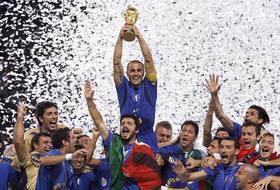
One month ago, Italy won the World Cup 2006.
Two months ago, almost exactly, I predicted that victory on this blog.
Optimistically, I suggested that the World Cup could kick start a new
trend in domestic political affair.
To a certain extent, that was correct. For example, it appears that the tax collection system saw a steep improvement in the last months. Needless to say, the previous government facilitated to a great extent those who were unhappy with the tax-system.
Unfortunately, Prodi's government is not very firmly grounded and it is likely that it will have to compromise on many policies, unless it gathers external support. A difference with the previous government, however, is already perceptible: when Berlusconi is not there, many Italians are much more optimistic about the future. Starting with its football system, which mirrored very well the level of corruption in Italian affairs.
Tuesday, August 08, 2006
What's wrong with CCTV Cameras?
Many people in Britain think that there is no problem with CCTVs.
In short, the arguent is that CCTVs mean crime prevention. And this, for many, is good enough to cut short the discussion and limit other interests at stake.
Any interest in privacy is clearly overridden by the increase of crime prevention, or so they say. Privacy intrusions are difficult to measure, while crime prevention is a matter of statistics. But is that the end of the story?
In Britain, the culture of privacy is very limited. In few words, we can distinguish three types of privacy: a geographical, a relational, and a personal privacy. Geographical privacy is determined by a physical space like the four walls of a house. Relational privacy is often called confidentiality, and presupposes that when an individual transmits an information to another, the latter is bound by an obligation not to disclose the information. Personal privacy has to do with information that the individual has never disclosed, but which are part of his genetic and experiential world.
Now, the problem is that privacy only depends on social contingencies and it is not supported by adequate reasoning. Personal privacy as applied to the ID debate in the UK, is considered as something inviolable and sacred, no matter what. Not even if it could help preventing terrorist attacks. ON the other hand, geographical privacy is too thin (as it only protects the life behind the four walls), and as a consequence an individual's actions in public can be scrutinized at length without raising any eyebrow.
Hence, the real problem is that many people assume without further reasoning that crime prevention is the overarching value that trumps any privacy interest in public. Perhaps, the most dangerous aspect of this story is that the likelyhood of a misuse of data gathered by CCTVs is always possible. The fear of being recorded in an inconvenient situation can raise, hence commanding a very standardised behaviour in public. Whoever deviates from the standard is likely to be recognized as a possible threat and controlled more closely. We go down a perilous slippery slope while the social standards of privacy continue to lower. And we end up naked in front of the camera, probably even without the protection guaranteed by the figue leaf of geographical privacy.
In short, the arguent is that CCTVs mean crime prevention. And this, for many, is good enough to cut short the discussion and limit other interests at stake.
Any interest in privacy is clearly overridden by the increase of crime prevention, or so they say. Privacy intrusions are difficult to measure, while crime prevention is a matter of statistics. But is that the end of the story?
In Britain, the culture of privacy is very limited. In few words, we can distinguish three types of privacy: a geographical, a relational, and a personal privacy. Geographical privacy is determined by a physical space like the four walls of a house. Relational privacy is often called confidentiality, and presupposes that when an individual transmits an information to another, the latter is bound by an obligation not to disclose the information. Personal privacy has to do with information that the individual has never disclosed, but which are part of his genetic and experiential world.
Now, the problem is that privacy only depends on social contingencies and it is not supported by adequate reasoning. Personal privacy as applied to the ID debate in the UK, is considered as something inviolable and sacred, no matter what. Not even if it could help preventing terrorist attacks. ON the other hand, geographical privacy is too thin (as it only protects the life behind the four walls), and as a consequence an individual's actions in public can be scrutinized at length without raising any eyebrow.
Hence, the real problem is that many people assume without further reasoning that crime prevention is the overarching value that trumps any privacy interest in public. Perhaps, the most dangerous aspect of this story is that the likelyhood of a misuse of data gathered by CCTVs is always possible. The fear of being recorded in an inconvenient situation can raise, hence commanding a very standardised behaviour in public. Whoever deviates from the standard is likely to be recognized as a possible threat and controlled more closely. We go down a perilous slippery slope while the social standards of privacy continue to lower. And we end up naked in front of the camera, probably even without the protection guaranteed by the figue leaf of geographical privacy.
Monday, August 07, 2006
Lebanese unhappy with draft UN resolution
The US, France and the UK have agreed on the text of a draft resolution on the crisis between Lebanon and Israel to be put before the Security Council. The text is, it seems, a compromise between the positions of the French and the Americans: the former won a concession in the two-phase strategy adopted (that is, a cessation of hostitilities as the first stage, followed then by a deal on an international peacekeeping force and a buffer zone), whereas the latter got its wish in removing all references to Israeli "disproportionality", and, indeed, in placing the more onerous ceasefire obligations on Hezbollah.
This US-won concession is undoubtedly the most controversial aspect of the draft text. It is contained in Operational Paragraph 1, which notes that "Calls for a full cessation of hostilities based upon, in particular, the immediate cessation by Hizbollah of all attacks and the immediate cessation by Israel of all offensive military operations". Of crucial importance here is to note that, while Hezbollah must immediately cease all military operations, the Israeli's are required only to halt "offensive" ones. Given the extent to which the definition of "defensive" has been stretched by the US and UK rhetoric in Iraq, it is small wonder that few on the Lebanese side view this as acceptable.
Nor, I think, should it be assumed that this is simply restating Israel's right to respond to any continuing Hezbollah agression in violation of the resolution, should it be adopted; few if any would hold them bound to a pact that the other side was willfully and materially breaching. Rather, it seems more likely that the wording of this provision has been made quite deliberately in order to allow Israel to continue activities that it sees as being of a "pre-emptive" defensive sort, which would, of course, include any and all attacks on Hezbollah positions and fighters, particularly in, but presumably not limited to, Southern Lebanon. Again, given the extent to which the Israeli's have sought to use that rhetoric to justify almost all of there actions, including the massacre of civilians in Qana, it is not surprising that a "ceasefire" on these terms strikes many as terminally one-sided.
Robert Fisk has an interesting piece in today's Independent outlining precisely why the Lebanese are less than enamoured with these mose recent fruits of Franco-American labour. High on his list of problems is simply the repetition of the same tired old rhetoric that followed the Israeli invasion of 1982, where the ideas of a "buffer zone" and disarmament were also central. Of course, this does not mean that the Lebanese will be able, ultimately, to reject it: on the contrary, the combined powers of the Security Council Members, should they all agree, are likely to be more than sufficient to make it stick. The difficulty is that, the more they have to make it stick, the less likely they are to be able to make it work.
This US-won concession is undoubtedly the most controversial aspect of the draft text. It is contained in Operational Paragraph 1, which notes that "Calls for a full cessation of hostilities based upon, in particular, the immediate cessation by Hizbollah of all attacks and the immediate cessation by Israel of all offensive military operations". Of crucial importance here is to note that, while Hezbollah must immediately cease all military operations, the Israeli's are required only to halt "offensive" ones. Given the extent to which the definition of "defensive" has been stretched by the US and UK rhetoric in Iraq, it is small wonder that few on the Lebanese side view this as acceptable.
Nor, I think, should it be assumed that this is simply restating Israel's right to respond to any continuing Hezbollah agression in violation of the resolution, should it be adopted; few if any would hold them bound to a pact that the other side was willfully and materially breaching. Rather, it seems more likely that the wording of this provision has been made quite deliberately in order to allow Israel to continue activities that it sees as being of a "pre-emptive" defensive sort, which would, of course, include any and all attacks on Hezbollah positions and fighters, particularly in, but presumably not limited to, Southern Lebanon. Again, given the extent to which the Israeli's have sought to use that rhetoric to justify almost all of there actions, including the massacre of civilians in Qana, it is not surprising that a "ceasefire" on these terms strikes many as terminally one-sided.
Robert Fisk has an interesting piece in today's Independent outlining precisely why the Lebanese are less than enamoured with these mose recent fruits of Franco-American labour. High on his list of problems is simply the repetition of the same tired old rhetoric that followed the Israeli invasion of 1982, where the ideas of a "buffer zone" and disarmament were also central. Of course, this does not mean that the Lebanese will be able, ultimately, to reject it: on the contrary, the combined powers of the Security Council Members, should they all agree, are likely to be more than sufficient to make it stick. The difficulty is that, the more they have to make it stick, the less likely they are to be able to make it work.
No Jobs for Smokers!
Europe does not like smokers anymore; this is fair enough. Europe is prepared to discriminate smokers on the job market. This is the latest frontier of dissuasion and it is a very controversial one.
Is it possible to discriminate on such grounds? It all depends on the reasons one puts forward to keep smokers at bay. Perhaps the World Health Organisation has a high moral ground to do so. It is fighting a global fight against smoke, and it would be slightly inconsistent if those who fight the battle are smokers. They are likely to be half-hearted.
Perhaps a sport club has a reason to insert a clause against smoke in the contracts with its sportsmen as smoke would lower performances.
It is less clear why a smoker would be discriminated against for a post of, say, telephonist in a call centre (the actual case which raised the problem). After all, the working environment is already smoke free. The smoker in question can only harm himself, but does not do anything that can be harmful to others in any possible way. Do we really want to punish him on top of his self-inflicted sanction deriving from the very fact that he is a smoker?
Is it possible to discriminate on such grounds? It all depends on the reasons one puts forward to keep smokers at bay. Perhaps the World Health Organisation has a high moral ground to do so. It is fighting a global fight against smoke, and it would be slightly inconsistent if those who fight the battle are smokers. They are likely to be half-hearted.
Perhaps a sport club has a reason to insert a clause against smoke in the contracts with its sportsmen as smoke would lower performances.
It is less clear why a smoker would be discriminated against for a post of, say, telephonist in a call centre (the actual case which raised the problem). After all, the working environment is already smoke free. The smoker in question can only harm himself, but does not do anything that can be harmful to others in any possible way. Do we really want to punish him on top of his self-inflicted sanction deriving from the very fact that he is a smoker?
Friday, August 04, 2006
Internationalization of Israel’s problems

In a comment in today’s Financial Times Lawrence Freedman, professor of war studies and vice-principal (research) of King’s College London, argues that when the war in Lebanon ends, Hezbollah will certainly end up militarily weaker, but politically stronger. He is also convinced that despite the recent Israeli abandonment of territories to which it aspired in the past, “their old enemies will not leave them alone”. Moreover, Israelis will no longer be able to defend themselves, as they are doing now, using traditional military means, for this reason Israel “has accepted in principle that any durable solution to its border problems must have an international dimension”. Thus, Freedman suggests that setting up an international force in Lebanon must be followed by possibly an establishment of a UN trust territory in Palestine, “with the UN responsible not only for internal security and economic reconstruction but (with a strong local input) for final negotiations with Israel.” Possibly, a more efficient alternative, to the establishment of a UN trust territory in Palestine, could be, a solution along the lines of Kosovo, NATO led international military force (to assure US involvement) to provide internal security for the Palestinian territories and a EU mandated civilian administration, built on a mixture of a Bosnian (Office of the High Representative) and Kosovo (UNMIK) model. As part of its European Neighbourhood Policy, EU must also be ready to take on itself a large part of the financial burden to finance such international deployment in Palestine.
Concerning the US Foreign Policy, Freedman is critical of the outcome of Bush’s strategy to spread democracy in the Middle East through military deployment. He is hinting at the possibility of a realignment (for the moment indiscrete) between the US and Sunni Islam moderate (and corrupt – my words not of Freedman) political leaders against aggressive Iran and radical Islamic parties. Vali Nasr, in Foreign Affairs argues differently, "By toppling Saddam Hussein the Bush administration has liberated and empowered Iraq's Shiite majority and has helped launch a broad Shiite revival that will upset the sectarian balance in Iraq and the Middle East for years to come. This development is rattling some Sunni Arab governments, but for Washington, it could be a chance to build bridges with the region's Shiites, especially Iran." As far as EU policy is concerned Freedman states that EU is full of wise words but that it does nothing and that it should because it stake in the future of the Middle East is even greater than that of the US. Related to this, implicitly, the author criticizes the US and French refusal to negotiate with Syria and Iran.
Thursday, August 03, 2006
EU in Lebanon: semantic bow to Washington and Tel Aviv or constructive pragmatism?

This blog entry presents an attempt to offer our readers a quick overview of the international press reporting on the diplomatic activities evolving over the war in Lebanon, especially concentrating on the analysis of the EU and EU member states foreign policy making related to the war and briefly outlining the US position.
Instead of an immediate cease-fire Israel has sent around 7,000 troops into Lebanon as part of the military campaign aimed at pushing the Hezbollah militia back from the border before a cease-fire is declared and a multinational force deployed, reports NY Times. Simultaneously Hezbollah has launched 200 rockets into Israel. According to reporting unlike the massive tank ground invasion of 1982, this time Israel is combining a frontal incursion into the Lebanese territory with a deployment of small commando units deep into Lebanese territory. With important military presence of Israeli ground troops in South Lebanon, any international deployment will have to seriously take into consideration Israeli interests before even thinking of deployment. This is the essence of the delay of the cease-fire. Ehud Olmert, Israeli PM said, “We are at the beginning of a political process that in the end will bring a cease-fire under entirely different conditions than before.” He also added that Israel would continue to fight until the international deployment. Newspapers report that France, the United States and Britain are close to agreement on a draft UN resolution that could lead to the deployment of an international force in southern Lebanon after a ceasefire between Israel and Hizbollah, a senior British official said. A lot has been said (from unnamed diplomatic sources from the EU) on a two-resolution approach. The first resolution, expected in the coming days, would establish a cessation of hostilities and lay out a political framework for the future. The second, to follow within two weeks of the first, would create a buffer zone in the south and authorize an international force to patrol it, and set out terms for a sustainable cease-fire, including disarming Hezbollah, establishing the borders of Lebanon, preventing arms shipments into the country and extending the authority of the Lebanese Army over all its territory. It is doubtful as to what would happen after the passage of the first resolution, what military force would remain in the buffer zone to enforce the truce after passage of the first resolution? Many mention the possibility of sending troops to have the enhanced UNIFIL, patrol the buffer zone until the deployment of a larger force. An alternative, preferred by the Israelis, would be to have Israeli Defence Forces (IDF) control the buffer zone until the deployment, which would in practice mean that the hostilities would last until the actual weighty international force arrives to Lebanon. The French are against this potion. Massimo D’Alema, Italian Foreign Minister, agrees with the French and expresses reservations versus a strategy of sending troops while the conflict is still in place.
Instead of calling for an immediate ceasefire, Council of the European Union Foreign Ministers, that convened 1 August, called for “an immediate cessation of hostilities, to be followed by a sustainable cease-fire.” Moreover, EU called for a rapid convening of the UN SC in order to define a political solution for the present conflict situation. At the same time Israel does not want to stop military operations until a political solution (acceptable to them) is at the table. The Guardian is harsh in its criticism of the EU Council’s statement, talking about the “collapsed efforts” to end hostilities, “divided EU”, “watered-down statement”, “semantic bow to Washington and Tel Aviv” etc. Le Monde and Speigel also write about the EU Council meeting. Apparently, on one side of the table was France (supported by the Finish Presidency, Sweden, Spain and Greece) who was calling for an immediate "ceasefire", while on the other side of the table Germany, UK, Poland, the Czech Republic managed to play down the statement and call for a "cessation" of hostilities. Everyone is now waiting for the convening of the UN SC, and in the mean time, despite the fact that the UK foreign secretary, Margaret Beckett, refused to accept that the “semantic bow” of the EU Council amounted to a "green light" for Israel to continue its military offensive, Israel does continue do drive into Lebanon with ground troops.
An interesting article of the Italian Corriere Della Sera, entitled “Anglo German axis” describes the nature of the new political alignment between the UK and Germany, arguing, “Italy has nothing to fear from this alliance but only to learn”. Whether interpreting the German position on the conflict in Lebanon as a strategic realignment away from France and versus a stronger transatlantic Europe is an exaggeration it remains to be seen, it can be also argued that Germany is cautious in its approach to this war due to the weight of history, in other words, due to the political impossibility of breaking the taboo of good relationship with Israel. Germany is reluctant, it has been said in the French Figaro to send troops because of its ‘historical’ position versus Israel.
At the same time German press writes that the German foreign minister coming from SPD already broke the historical taboo and hinted at the possibility to send German soldiers to the Middle East, arguably as part of an attempt to court the left wing of SPD but not to render hostile their partners in the Grand Coalition. Yet, deploying Germans at the border with Israel while the hostilities still last would be unthinkable and it seems that the Germans would rather be deployed as part of the same multinational force, later and somewhere at the border with Syria. German PM also mentioned the over deployment problem that is currently burdening the German army.
It would be a fallacy to consider that the UK government is standing firmly behind the strong Transatlantic policy of its PM. As far as the UK internal politics is concerned, claims The Independent, there seems to be a heavy disagreement within the very Cabinet of the UK’ PM Tony Blair. While his foreign secretary preferred for the EU issuing an immediate call for cease fire, Blair was more lenient towards Israel, or better towards the political platform of the US administration, “As he returns to Britain today, Mr Blair will find himself an isolated figure in his own Cabinet over Lebanon. The dissent among senior Labour figures over Britain's approach to the conflict is now being seen as a growing challenge to the authority of the Prime Minister.” There were also signs that the foreign secretary might ask the US to stop using British airports to send military aid to Israel. Jack Straw, the former foreign secretary, publicly disagreed with the policy of Blair, and talking to a Muslim population in the UK, called the Israeli bombing, "disproportionate". There were even gossips, writes the Independent, that Mr Straw was ‘moved’ from the position of Foreign Secretary, on the demand of the US Administration and allegedly “because of the high number of Muslims in his constituency”.
After the 1 August EU Foreing Ministers meeting, the German Foreign Minister Frank-Walter Steinmeier defended the position that a call for an immediate cease-fire did not go through, because it would be rushing things without considering the realistic situation on the ground. After the meeting however, both the French and Finish Foreign Ministers, tried to tone down the disagreement at the Council arguing that, “the most important thing” is that the hostilities end (the Finish) and that he is happy that the EU, “spoke with one voice” (the French). Assessing the exit of the above mentioned EU Council meeting on the crisis in the Middle East, it would be wrong to lament on the lack of unity – it is rather normal that there is disagreement when 25 foreing policies need to reach an agreement on a sensitive geopolitical issue such as the crisis in the middle east. What is on the other hand worrying is a significant lack of coordination in the EU foreign policy towards the larger context of the Lebanon conflict. Namely, while Germans and the UK dialogue with Syria considering it to be “the key to the resolution of the conflict”, France refuses to talk to them and goes to Iran instead. Some unnamed EU diplomats told the Figaro journalist that France acts inconsistently, while it pretends to play the key role in the international peace keeping force to be potentially sent to Lebanon, it refuses to negotiate with the key player in the region Damascus. Many consider that the French attempt, “to play Iran against Syria is very hazardous”. French Foreign Minister said that, “we judge that we do not need to enter into discussion with Syria” and replied to the question whether Javier Solana, The High Representative for the Common Foreign and Security Policy, should go to Damascus, “Ce n’est ni d’actualité ni souhaitable”. French daily Liberation is very critical towards the French refusal to negotiate with the Baathist regime of the Syrian President Bachar al-Assad. The French newspaper is questioning the French strategy of referring to Iran when in fact “this country is the true sponsor of Hezbollah”. The article also reports that the French President called the Italian PM Prodi to prevent the establishment of a telephone contact between the Italians and Syria. In an interesting interview to the Italian Corriere Della Sera, Israeli PM Olmert, apart from stating that he was happy to see Italy win the world cup (he did not mention that he was happy to see the French lose), said, “Prodi is a good friend, but what results did his telephone conversation with Assad produce?”
On the other hand it seems that the EU reached a consensus on the support of the French plan for the political resolution of the conflict to be presented at the UN SC. The essence of the French plan is to have an immediate cease fire, to reach a political agreement for Lebanon and to deploy an international peace keeping force in which France is ready to play a leading role said in an interview to the Figaro French Foreign Minister. France’s defence minister, Michèle Alliot-Marie, said in an interview published Tuesday that any international force should have 15,000 to 20,000 troops, far larger than the current UN force posted there, and have rules of engagement that would permit its soldiers to open fire when necessary. On the contrary US President Bush continues talking of supporting the Lebanese “young democracy” and restoring Lebanese military control over its southern border with Israel. The French Plan provides for the future multinational force to be headed by UN, not NATO, because, as the French Foreign Minister argues, NATO led force “risks being considered by the public opinion in the region as a Western force”. There we plans to send a UN military contingent led by France and Turkey. Spanish El Pais writes that Spain is ready to send up to 800 troops to the international military mission in Lebanon. Moreover, Spanish experts consider that the contingent must have 10,000 to 20,000 soldiers, act under Chapter VII of the UN Charter which authorizes the use of force against all parties in order to assure that the previously designed political agreement is respected. The contingent must count on a generous financial and military European contribution, although the presence of some Arab country would be desirable, consider Spanish experts. Spanish seem to agree to a French led contingent but arguably prefer (for reasons of technical and military efficiency) that the operation is directed by NATO. Italy is also said to be ready to send troops to Lebanon but, in line of the Political Programme of the new PM Prodi, strictly as a part of the UN led peace-keeping force. Apart from these countries Belgium, Sweden, Ireland, and as already mentioned, possibly Germany, seem ready to send troops to Lebanon. Turkish army is ready to send up to 1500 soldiers to Lebanon but is asking for a clarification of the mandate of such a force before deployment.
As far as the US is concerned, although he branded the killing of dozens of Lebanese civilians by Israel’s military forces as “awful”, US President Bush continues to see the situation in Manichean terms (that essentially suit his political calculus), for Bush, what we see in the Middle East is the clash of forces of freedom and the forces of terror. US administration remains fully supportive of Israel’s military activities and to counterweight that calls for a “sustainable” cessation of hostilities. Bush also called directly on Iran and Syria to stop supporting terrorism in the Middle East. To counterbalance the mentioning the murder of civilians in Qana, Bush had to add that “…million Israelis are worried about rockets being fired from their, from their neighbour to the north.” US administration can continue to full heartedly support Israel because, as NY Times notes, White House officials are convinced that despite the recent criticisms from the Congress Republicans, “president was not yet facing serious erosion of domestic political support for his approach to the Middle East.” Israeli Jerusalem Post made an interesting analysis of the US policy towards the crisis in Lebanon. According to this report, US support to the Israeli actions comes from the very top of the administration, the White House. What seemed at first as lack of decisiveness of the US Foreign Policy, now appears rather as a “meticulously elaborated strategy”. Jerusalem Post argues that US has a unique opportunity to bring some order in this unstable region, to clean Lebanon of Hezbollah and reinforce the democratic government in Beirut.
[In order to read quoted newspaper articles in different languages using an automatic and free web translator please visit this web site]
[UPDATE: For an interesting report on the crux of French-US/Israel disagreement over the strategy of deployment of the international force see here, "While most of the international community is likely to back the French demand for an immediate end to the fighting, followed by a cease-fire agreement to allow for the deployment of an international force to police such a truce, the U.S. is insisting that there be no demand for a halt to Israel's offensive until a mechanism is in place to disarm Hizballah. These differences are not diplomatic hair-splitting — they reflect profound differences over the fate of Hizballah. The only acceptable outcome for the U.S. is a defeat for Hizballah, because if the movement survives the onslaught with its independent military capability intact, it will be seen throughout the Arab world as the victors.
But the French, who are currently the prime candidates to lead an international force, are making clear that the international community is not going to finish the job for Israel, and will only police a cease-fire when one has been agreed to by the Lebanese government, which includes Hizballah. In other words, it won't try to disarm Hizballah unless Hizballah has agreed to be disarmed. And the only formula likely to achieve that objective on the basis of the current battlefield situation would be an agreement among Lebanese parties to somehow incorporate Hizballah's fighting forces into the Lebanese Army — which may not be quite what the U.S., and certainly not Israel, had in mind."]
Wednesday, August 02, 2006
Symposium organized by a Blog
Interesting initiative launched by Opinio Juris. A symposium organized by a Blog on an interesting topic: Challenges to Public International law.
I am sure many will respond enthusiastically.
I am sure many will respond enthusiastically.
Tuesday, August 01, 2006
Lebanon 2006-Respect for Humanitarian law vs. right to exist
On 12 July 2006 in the morning Hezbollah, Iran and Syrian sponsored terrorist organization used the territory of Lebanon to attack Israel’s territory and its army, sever soldiers were killed and two abducted. Israel attacked mounting bombardments an ground offensive on Lebanon that for the moment counts more than 500 civilian victims. Hezbollah on its own part continues to counter the humanitarian norms of international law by continuous launching of inaccurate missiles into the territory of Israel. We are currently facing numerous potential conflicts related to the situation in Lebanon, first and most obvious conflict between Israel and Hezbollah and Israel and the Lebanese army, second diplomatic (although uneven) tug of war between the US and certain EU states over the strategy for the resolution of the conflict, thirdly a conflict between the terrorist organizations over popularity in the Arab World, Al Kaeda seem to feel its popularity being under threat vis-à-vis Hezbollah, fourthly conflict between the Suni Arab World (Saudis, Egypt) and Iran and Syria etc.
Antonio Cassese, a prominent Professor of international law, and an ex-judge and President of the International Criminal Tribunal for the former Yugoslavia (1993-2000), in an article, “Beyond every legal principle”, published in the print edition of the Italian daily newspaper “La Repubblica”, analyzes the situation in Lebanon from the point of view of international law and gives a generally interesting twist to the debate on the present conflict in this country.
Cassese writes, that in normal circumstances, attack on the border patrol of one country from a territory of a neighbouring country would require immediate negotiations and the state from which the attacks occurred would have to immediately act in order to repatriate the hostages and to conduct a thorough inquiry to punish the guilty party. Israel’s immediate bombardments of Lebanon, were nevertheless justified because, in the case of Lebanon, Cassese writes, the actions of Hezbollah do not represent actions of a State, “but came from Armed Forces that operate in Lebanon escaping the control of the Lebanese government. Therefore it would not have served anything to demand from the authorities of Beirut the repair the damages inflicted by the illicit acts.” Yet, Cassese adds, initial justified reaction of Israel, went beyond the rules of international humanitarian law.” Then Cassese carries on to name several incidents in which Israel tried to justify each of its actions while bombarding Lebanon (e.g. bombarding of the Beirut international airport was necessary in order to prevent Hezbollah receiving more arms etc.) These justifications are not convincing for this eminent Italian jurist, he says, “if a singular military operation may appear justified, the ensemble of actions exposes the radical disproportion between the evident aim (to place term to the attacks of Hezbollah and to obtain the restitution of the hostages) and means used (the immediate destruction and on immense scale of all the Lebanese infrastructure, with most serious effects on the civil population). For Casssese, and most of the ‘international community’ bombardments of Cana and the murder of children is undoubtedly an example of such excess.
On the other hand, Cassese obviously does not seem close to the political sensibility of Giuliano Amato, his colleague professor and Italian Minister of the Interior and ex-Prime Minister, who argued that it is absurd to talk about proportionality, “as if we were talking about accountancy and not about the survival of a state [hinting at Israel].” (according to Cassese’s commentary) In another article in the Italian daily Corriere Della Sera Amato argued similarly, “Israel is, for nth time in the history, facing the same troubles, to know itself surrounded by enemies who deny its right to the existence ".
Facing the probability of sending a massive international peace keeping force to South Lebanon, Amato’s arguments seem weak. However, facing the low probability of mounting an effective (politically and militarily) international force, it can be argued that Israel has the right to be worried (which still does not justify the excessive victims caused by the collateral damage of Israeli bombings).
Arguably, if effective, this international force would also, to a certain extent, contribute to the feeling of security of the state of Israel. It is for the moment politically unrealistic but worth considering of sending such a force on the divisive line between Israel and Palestine, such a solution would not be without benefits for the people of Israel. Israel’s politicians are sceptical, they are asking for more time and they seem to be ready to accept international involvement only if NATO (read the US, not the UN) plays the leading role in this.
Recent Italian attempt to reach an international agreement on resolving the present Middle Eastern Crisis for the moment failed. American administration still seem reluctant (although the situation is changing) to put the pressure on Israel to accept the terms offered by some other international actors. Today the Council of the European Union met to discuss the situation in Lebanon and there is a likelihood that some agreement, amongst other thins, on the international force will be reached. Simultaneously, in the US, a prominent Republican Senator Hagel in an eloquent speech, challenged President’s current stance on Lebanon, urging President Bush to turn all U.S. efforts toward "ending this madness," and calling for an immediate cease-fire in the Mideast.
Numerous US based think tanks seem to be critical of the US lenience towards Israel, among which International Crisis Group in its brand new report “Israel/Palestine/Lebanon: Climbing Out of the Abyss” and the Brookings Institution.
It remains unclear how can this international force be constituted (will US be playing a significant role in the military contingent – which seems extremely unlikely bearing in mind the current situation of extreme global military overstretch) and what are the prospects for Hezbollah agreeing to international demands to accept the Lebanese government's authority and begin the process of disarming? Can the conflict between the Palestinian Authority and Isreal be resolved in a simmilar manner?
The Judge (Emperor) is Naked!!
Jeremy Waldron reviewed Ronald Dworkin's latest book Justice in Robes on the New York Review of Books. (you can only access it in full if you're subscribed).
It is not a particularly good review, which probably mirrors the fact that it is not a particularly good book. The usual Dworkin, but this time much more aggressive towards its critiques. Posner, Rorty and others are vigorously (if not violently) treated and the argument does not benefit out of it.
The only interesting piece is an article on value pluralism in response to Isaiah Berlin. Dworkin attempts to play down value pluralism, but he is not quite convincing. Especially not so when he concludes in the end that it is better to hope that the sacrifices predicted by value pluralism could be avoided. We all hope that no sacrifices are necessary to live together in a harmonious society. But, the hope is very thin and should not disguise the necessity of some trade-offs. In particular that hope should not prevent us from understanding when and how to deal with sacrfices of value.
It is not a particularly good review, which probably mirrors the fact that it is not a particularly good book. The usual Dworkin, but this time much more aggressive towards its critiques. Posner, Rorty and others are vigorously (if not violently) treated and the argument does not benefit out of it.
The only interesting piece is an article on value pluralism in response to Isaiah Berlin. Dworkin attempts to play down value pluralism, but he is not quite convincing. Especially not so when he concludes in the end that it is better to hope that the sacrifices predicted by value pluralism could be avoided. We all hope that no sacrifices are necessary to live together in a harmonious society. But, the hope is very thin and should not disguise the necessity of some trade-offs. In particular that hope should not prevent us from understanding when and how to deal with sacrfices of value.
The end of Castro?
The news that Fidel Castro, 'lider maximo' of Cuba, has handed to his brother the power because of a health problem has been met with different reactions.
Le Monde simply says that this is an interim situation, while the italian Corriere della Sera emphasizes the possibility of a more permanent move. The New York Times, underrates the news by referring to a temporary problem.
Given that Castro is 80 years old and his health seems to be worsening, it would be interesting to imagine a post-Castro scenario. Would his brother command as much authority as Fidel? Would the expats go back to Cuba if Castro died? Would the regime change? I believe we'll know more about this fairly soon.
Le Monde simply says that this is an interim situation, while the italian Corriere della Sera emphasizes the possibility of a more permanent move. The New York Times, underrates the news by referring to a temporary problem.
Given that Castro is 80 years old and his health seems to be worsening, it would be interesting to imagine a post-Castro scenario. Would his brother command as much authority as Fidel? Would the expats go back to Cuba if Castro died? Would the regime change? I believe we'll know more about this fairly soon.
Wednesday, July 26, 2006
Berlusconi's Surprise Party
Zorro Berlusconi dances masked in Morocco for his wife. Our national arlequin found yet another disguisement. Many think that he could have been a great show man, many think he is. Read here for more details on the 'genius' of entertainment.
Monday, July 24, 2006
Apologies to our readers
Due to summer holidays, we decreased the number of our postings.
We'll be back soon with plenty new insights!
Please keep visiting us
We'll be back soon with plenty new insights!
Please keep visiting us
Wednesday, July 12, 2006
Should the U.S. Welcome a More Assertive Japan?
Despite the extensive coverage of North Korea’s missile tests last week and the responses of the various concerned countries – the E.U., U.S., Japan, China, Russia and South Korea - an important aspect of this story remains unexamined. The media has covered Japan’s tough reaction to the tests - it has proposed a U.N. resolution that would impose sanctions upon Pyongyang and publicly pondered the advisability of pre-emptive strikes against North Korean missile launch sites – and subsequent Chinese and South Korean criticism of Japan. However, the growing public popularity of a more assertive Japanese foreign policy, and the politicians who espouse it, has been largely ignored. This is an important development from the American perspective and one that deserves closer analysis. Almost immediately after the end of World War Two American policy makers recognized the need for a rehabilitated, strong Japan to serve as a counterweight to Soviet power in Asia. Thus, even as they oversaw the writing of the Japanese Constitution, which includes the famous Article 9 forbidding war or the threat of force in international disputes, U.S. policy makers began pushing Japan to be more assertive on security issues. American encouragement of a bigger Japanese role in the East Asian security scene, and Japanese rejection of such a role, is a central theme of U.S.-Japanese relations over last 60 years. President Bush, like his predecessors, has pushed Tokyo to play a more active role in international security. He gained an important, if largely symbolic endorsement of this stance from Japanese Prime Minister Junichiro Koizumi in 2003 when Koizumi convinced the Japanese Diet to allow him to send an essentially non-combatant contingent to Iraq. This marked the first time that Japan sent troops abroad since 1945. Now, nationalist politicians are using the Japanese public’s hostility toward North Korean (which has, amongst numerous unneighborly acts, abducted a number of Japanese citizens over the years) to garner support. Chief amongst these are the popular Tokyo Governor Shintaro Ishihara, Japan’s most famous nationalist, and Koizumi’s chief cabinet secretary Shinzo Abe, widely considered Koizumi’s likely successor, who made his career largely on his hawkish stance toward North Korea. Abe and rival Taro Aso, the Foreign Minister, raced to be the first to condemn the missile tests last week. To the Bush administration this growing foreign policy assertiveness, especially on North Korea, must seem like a boon. However, while Washington will probably welcome this tougher approach from Tokyo, it should recognize the complications that will accompany such a change. That China and South Korea seem as nervous about Tokyo’s response as they do about North Korea indicates the deep historical cleavages that influence foreign relations in East Asia. Japan’s wartime atrocities in China, South Korea and elsewhere are common knowledge. However, less understood is the fact that the Japanese, unlike the Germans, despite their pacifist image, have failed to fully examine and acknowledge their forebears' World War Two behavior. Aside from the annual media coverage of Japanese Prime Ministers visiting Yasukuni Shrine (which honors, amongst many others, 14 men executed for war crimes), most foreigners fail to grasp the depth of the problem. This is highlighted by the fact that Ishihara, Abe and Aso, all successful politicians, have all made statements about Japan’s role in World War Two that would be career-enders for any German politician. It is not accidental that, despite close economic and cultural ties, Japan’s relations with China and South Korea are barely civil. With the growing popularity of nationalist politicians and public acceptance of their rhetoric (and presumably policies) on many issues, U.S. policy makers need to account for the increased friction that seems likely to accompany Japan’s more assertive foreign policy. After all, the relationship with Japan is the central component of Washington’s security policy in East Asia. The U.S. itself has complex, often troubled relations with China and South Korea and it does not need the added burden of worsening relations between them and Japan. If Japan continues to embrace a more assertive, nationalistic foreign policy, Beijing and Seoul will react sharply. Mediation by the U.S. – the linchpin of East Asian security relations – will require intensive diplomacy to bridge differences between Japan and its neighbors. Unfortunately, such engagement is unlikely from a Bush administration occupied with other problems and not especially adept at bridge-building . Look for rougher waters in East Asia in the next few years.
Tuesday, July 11, 2006
Democratization of Sovereignty

"With our blood we coloured the soil, with our bones we marked the borders. Around the Church lie the tombs of 25 Serbian Heroes of the Kolubara battle 1914."
Montenegrin referendum demonstrated that peaceful secession through a democratic process can be a realistic alternative to the separation or unification of states through the agreement of political elites or to violent secession through war. The same could occur in the Serbian breakaway province of Kosovo and Metohija, although it is uncertain of what the eventual outcome of its independence will be? Invoking the principles of international law the Serbian government defends a strong and legitimate position that an imposed independence of Kosovo remains unacceptable.
Can the processes in the Balkans trigger similar developments in the rest of Europe and the world? Autonomous provinces of Spain, just to offer an example, looked with great interest at the events of the Montenegro referendum and it is not excluded that some time in the future constituent parts of EU member states might ask for independence.
The European Union, it can be argued, possibly represents a safety niche that can accommodate such independence claims without disrupting the political stability of these countries. As to whether this is possible in other areas in the world, one should be extremely sceptical, since we are still living in the era where nation states have absolute power and beyond the nation states individuals have very little rights. Borders still matter very much and embarking on a project of democratization of sovereignty is very dangerous outside of the context of the European Union. Independence claims of any territorial entity must be resolved taking into account the interests and political stability of the larger state from which it wishes to secede. Internal enlargement might play the role of a compromise solution but this is unfortunately realistically conceivable (in the long run) only within the boundaries of the EU, nowhere else.
Monday, June 26, 2006
The Greatest Alibi: Serbian Radical Party
Recent opinion polls in Serbia demonstrate a sharp rise of the populist, ex-Milosevic ally, Serbian Radical Party. To be more precise, the popularity of all major parties is in decline (including the Radicals), why Radicals demonstrate growth is because they have a more disciplined base that is less likely to abstain on future parliamentary elections, and an increasing number of the Serbs who is pro-European oriented, who decide to abstain.
A recent article in the Serbian daily Blic tries to offer an answer to such political situation in Serbia. Answering the question, I paraphrase, why do Serbian voters have enough, Slobodan Martinovic says,
“Because the democratic block of parties in Serbia demonstrated that power serves only for fulfilling their own personal needs: employment, personal wealth etc. In one word: Pure egoism. Me and once again me.
Because the political elite has no vision of the future, no courage and honesty to face the major problems in the country.
Because everything is the same as before 5th October [5/10/2000 The downfall of Milosevic] Who was powerful then, still is, who employed its children then, still does, who was unemployed then, is unemployed now.
Because they were not honest in their intention to create a normal and stable country. Everything around here is pure improvisation.
Because my friends with whom I fought for a better tomorrow betrayed me. They needed me only in order to come to power, then they forgot me.”
This emotional account to a large extent describes the frustration of many of the Serbian voters. It can be even provocatively argued that the Serbian Radical Party presents the greatest possible alibi for the largest part of the block of pro-European parties in Serbia. Now they can at least say, vote for us, because if you do not or if you abstain Radicals will win. Without the populist, chauvinist and corrupt, ex-Milosevic ally, Serbian Radical Party they would have no excuse any more they would have to explain what they did to assure Serbia’s speedy integration into the EU. They, with no exception, would have a hard job explaining their positive role.
Monday, June 19, 2006
Election Year Politics, American Style
It is only June, but American politicians are already acting with an eye to November’s mid-term elections. Everyone knows that looming elections can cause funny behaviour in American politicians, but Presidential and Congressional conduct has been bizarre even by American standards this year. Take, for example, President Bush’s recent re-discovery of a favourite issue of social conservatives, a push to amend the U.S. constitution to ban same-sex marriages. The measure, which Republican leaders have periodically resurrected over the last few years whenever they feel the need to reinforce their standing with social conservatives, has no chance of gaining the necessary two-thirds majority in the House and Senate and then approval by three-quarters of the states. After a series of speeches to generate sufficient press coverage and mollify social conservatives, Republican leaders will surely abandon the issue until the next time they need to rally their base. Seeking to rally liberal opposition to the measure in his bid for the Democrats 2008 Presidential nomination, Senator Russ Feingold stormed theatrically out of a Senate Judiciary Committee meeting last month after scolding Committee chairman Arlen Specter. A similar issue that commands broader support is the proposed amendment, recently approved by the Senate’s Judiciary Committee, to protect the American flag from “desecration.” Even some members of the Democratic Party, who can usually be depended upon to oppose such silliness, have supported the idea, eager to shed the image of Democrats as out of touch with mainstream Americans. Democratic Senator Dianne Feinstein supported the measure, and Democratic Senator Hillary Clinton recently co-sponsored a similar measure. Congressional debate regarding more vital issues has been no less circus-like. The issue that seems to elicit the most concern from voters centers on so-called “border security,” with most conservatives advocating harsh treatment for illegal immigrants and complicit American employers Many others support more moderate measures, like various amnesty plans that would provided paths to citizenship for many illegal immigrants. However, even these moderate plans have ridiculous elements to them, like President Bush’s call for stationing 6,000 National Guard troops along the U.S.-Mexican border, an absolutely useless - but not costless - gesture. The apex of this silliness came in April when the Senate voted to divert $2 billion from funding for operations in Iraq to programs concerned with halting illegal immigration. There are no coherent proposals on how to use this money, but in an election year, it is the gesture that counts. Iraq was the focus of perhaps the weirdest Congressional spectacle, recent non-binding votes in the House and Senate engineered by Republican leaders that rejected any sort of timetable for withdrawing American troops from Iraq. While these votes were relatively harmless wastes of time and money designed solely to embarrass Democrats, more troubling is the decision, yet again, to fund operations in Iraq “off-budget.” This accounting manoeuvre, which in effect allows Congress to write a massive check but to defer payment to a later date, is becoming habitual with Congress and highlights the growing budgetary problems the U.S. faces. Despite this extensive list of political absurdity, the idealist within me demands that I end with a tribute to a politician who appears to take the idea of public service somewhat seriously. Arlen Specter, the senior Republican Senator from Pennsylvania, has embarked on a lone, quixotic crusade to force the Bush administration to publicly explain their Orwellian domestic surveillance program. Americans seem largely unconcerned or unaware of this program – the Bush administration’s claim that is it necessary to “fight terrorism” has been, once again, sufficient to extinguish latent Congressional and press criticism. This endeavour is not earning him points with conservatives, but it is heart-warming to see at least one politician determined to serve the public interest, even in an election year.
The King of Italy aka the King of the Banana Republic
Emanuele di Savoia left Italy just after the WW2. Italy opted then for the Republic and sent the King away.
Two years ago, thanks to Berlusconi, the ex-King of Italy was allowed to come back.
Today, he is in prison. Perhaps this shows that no matter what you do, or who you are, corruption is endemic in Italy when you have the right (wrong?) connections.
Le Roi est mort...Vive la Republique
Two years ago, thanks to Berlusconi, the ex-King of Italy was allowed to come back.
Today, he is in prison. Perhaps this shows that no matter what you do, or who you are, corruption is endemic in Italy when you have the right (wrong?) connections.
Le Roi est mort...Vive la Republique
Thursday, June 15, 2006
New Ranking of UK Law Schools
Just published on the Times Good Universities.
Have a look here
Interestingly 5 Scottish law schools made it to the best 20. Aberdeen Law School, my place, is number 5, just after Cambridge, Oxford, LSE and UCL.
Have a look here
Interestingly 5 Scottish law schools made it to the best 20. Aberdeen Law School, my place, is number 5, just after Cambridge, Oxford, LSE and UCL.
Tension between US and Italy regarding unresolved Calipari Case
The new Italian government pretends more collaboration from the US as regards the mysterious case of Nicola Calipari, shot in Iraq by American soldiers.
D'Alema will meet Condi Rice to discuss about this issue soon. The Corriere della Sera reports that: "At the present time, Lozano is accused of attempted murder without specific aggravating circumstances. In the charges filed, the public prosecutors underline “the conclusions of the experts and the detailed report from which it emerges that the vehicle was moving at a fitting (permitted and suitable –Ed.) speed for the area and in any case not in a manner that could be perceived as “hostile”, and that the said vehicle should be fired upon, which reconstruction shows occurred at the same time the target was illuminated, not only exceeds the rules of engagement, but goes far beyond them”. The magistrates further underline that “no evidence has emerged in support of the putative justification for the incident, based on excusable error (illegitimate use of weapons or legitimate defence), that could led to a ruling that there are no grounds for action”.
D'Alema will meet Condi Rice to discuss about this issue soon. The Corriere della Sera reports that: "At the present time, Lozano is accused of attempted murder without specific aggravating circumstances. In the charges filed, the public prosecutors underline “the conclusions of the experts and the detailed report from which it emerges that the vehicle was moving at a fitting (permitted and suitable –Ed.) speed for the area and in any case not in a manner that could be perceived as “hostile”, and that the said vehicle should be fired upon, which reconstruction shows occurred at the same time the target was illuminated, not only exceeds the rules of engagement, but goes far beyond them”. The magistrates further underline that “no evidence has emerged in support of the putative justification for the incident, based on excusable error (illegitimate use of weapons or legitimate defence), that could led to a ruling that there are no grounds for action”.
The Age of Penelope: Sicily 2006

-Do you see the graffiti of the obscenity (male reproductive organ) on the bus next to us-asks the old man sitting in the Public Transportation bus of the Municipality of Siracuse, Sicily.
-Yes-responds a confused tourist.
-It is not some hooligans who are doing this, it is the actual bus-drivers-claims the old man.
-Do you know who is Penelope?-asks the old man.
-No-responds a confused and by now embarrassed tourist.
-My god!-cries the old man and then engages in a lengthy explanation-Penelope is the wife of Ulysses from the Greek mythology. Ulysses and Penelope lived together in a marriage for more than a year when it was interrupted by the Trojan war, to which Ulysses had to go. During his long absence, and when it was doubtful whether he still lived, and highly improbable that he would ever return, Penelope was importuned by numerous suitors, from whom there seemed no refuge but in choosing one of them for her husband. Penelope, however, employed every art to gain time, still hopping for Ulysses' return. The most famous of her arts of delay was engaging in the preparation of a robe for the funeral canopy of her husband's father. She pledged herself to make her choice among the suitors when the robe was finished. During the day she worked at the robe, but in the night she undid the work of the day. This is the famous Penelope's web, which is used as a proverbial expression for anything which is perpetually doing but never done. You see, in this way the bus drivers from Syracuse drive the buses during the day and during the night draw reproductive organs on them. In this way they can claim funds for the refurbishment of the buses, and where there are funds (structural funds from the EU or funds coming from the Italian government) there is spillover of some of the funds to the private pockets.
-Really?-asks the doubtful and confused tourist.
-Yes. It is like this in Sicily for ages, they build motorways that lead to nowhere, the railways system is in shambles and the state is nowhere to be found. This is why I left for Venezuela-says the old man.
-And what did you do there?-asks the tourist, himself coming from a country bearing many similarities with Sicily, apart from having the sea, maybe only in the metaphorical sense.
-Well I am a tailor and I went there to develop my business.
-And did you succeed?
-No not really, everyone there, at least in the part of the country where I lived, goes around half naked, there is very little work for tailors, so I returned.
The tourists gets off the bus and stops over to by a pizza. In Sicily everyone talks to you, this is a rather pleasant surprise and probably difficult to cope with for many tourists coming from other colder places. Talking with the young owners of the pizza take away place the tourists found out that the pizza owners are locals from Syracuse but that they emigrated to the North of Italy couple of years ago. They, especially the husband, loved living in the colder but richer and much more organized north, then, as the husband put it, “a misfortune” happened to them and they had to return. The wife explains that the “misfortune” was actually that she got pregnant so because of financial difficulties that the pregnancy entails they had to return to the niche of their parents home.
Walking around Syracuse the tourists also met rich people, saw many empty houses and found out that citizens from more prosperous EU states are buying of property in the town. They were also told that all the houses have to be restructured in a particular fashion and that this job (polishing the particular type of stone used to build the houses in Syracuse) is being conducted by an expert old man, and that there is only one still living in the town, he charges 500 Euros a day. The tourist thought, he must work very slowly, because he is old to be clear not for other reasons, a more cynical tourist of the two thinks that maybe he employs Penelope's strategy.
Slightly, to the north of Syracuse, in Catania, the tourists engage in looking at the walls of the city. They see the graffiti saying, “the throbbing youth carves up the river of uncertain hopes” (la gioventu’ pulsante scolpisce il fiume delle speranze incerte).They also see a hand made newspaper exposing an allegedly corrupt policeman, they were particularly struck by the following sentence, “all the varnish in the world could never hide the rust on your medals-you fucking Mafioso”. At the end they look at Etna, they do not manage to see it because of the clouds, but to compensate go and listen the poetry of a young and beautiful Tuscan visiting Sicily and writing about Etna, “smoke and fog, hell becoming paradise” (fumo e nebbia, un inferno diventa il paradiso). The tourists get drunk with the Tuscan poet…
-history of the human race is a spit in comparison to the ocean of time. The well being of the Earth and nature should come first and only then the well being of the human race, this is what I was listening, this is what the lava was telling to me, when walking around the rocks of what ones used to be lava-says the tourist who thinks he is really intelligent and who discovers his leanings towards the philosophy of the radical greens.
The young Tuscan poet does not listen to him she repeats in her head, “fumo e nebbia, un inferno diventa il paradise… fumo e nebbia, un inferno diventa il paradise…” The drunk tourist stares at the poet realizing that she in fact bares striking resemblance with Carmen Consoli, or at least how he imagines Carmen Consoli to be, when he looks at the Tuscan poet he feels the energy from Carmen’s songs and he is in love...with the Tuscan poet, not Carmen Consoli, and he is in love with Sicily. The tourist that is.
Wednesday, June 14, 2006
Lords reject civil torture claim
I called this one wrong. The recent (2004) Court of Appeal judgment in Jones v. The Ministry of the Interior Al-Mamlaka Al-Arabiya as Saudiya (The Kingdom of Saudi Arabia) has been overturned on appeal by the law lords. I have only had time to skim a couple of the judgments, but the crux of the matter seems to be that the Court of Appeal erred in interpreting Pinochet No. 3 as holding that the Torture Convention implied that acts it covered could never count as "official" for the purposes of state immunity. The relevant passage from Lord Bingham reads as follows (para. 19):
The claim, then, is that the Pinochet judgment decided that the torture convention implied a specific exception to the rule of state immunity in criminal proceedings only; and the Court is unprepared to, as I suggested it might, turn back on the dicta of Lords Millet and Phillips (as Lord Phillips himself did in the Court of Appeal judgment) that the state, while not impleaded in criminal cases, is indirectly so in civil proceedings and as such immunity attaches to the latter.
On this point, Lord Bingham notes the "error" of the Court of Appeal
1) Based on the Arrest Warrant decision of the ICJ (ICJ Rep 3 [2000]), which held that immunity rationae personae can be claimed for a serving foreign minister accused of crimes against humanity, it is clear that the international prohibition of such norms, "having the same standing as the prohibition of torture", does not override all other rules of international law, including those on state immunity. He also cites an unreported ICJ case, Democratic Republic of Congo v. Rwanda (3rd Feb 2006) as authority for the propostion that breach of a norm of jus cogens is not itself sufficient to create jurisdiction in national courts.
2) Article 14 of the Torture Convention does not create universal civil jurisdiction. Both Lords Bingham and Hoffman (paras. 20 and 56 respectively) note the "understanding" lodged by the US at the time of its ratification of the Torture Convention to the effect that "Article 14 requires a State Party to provide a private right of action for damages only for acts of torture committed in the territory under the jurisdiction of that State Party", which received no objection from other Parties. Even though this was twenty years ago, it is unlikely that the US will have changed its mind, or that a norm of custom to the contrary will have crystallised in the intervening period.
3) The UN Immunity Convention of 2004 (signed but not yet ratified by the UK, but still held to be "the most authoritative statement available on the current international understanding of the limits of state immunity in civil cases" - for an analysis, see here) makes no reference to an exception for torture or other jus cogens, a fact which is "wholly inimical to the claimants' contention" - also noting that many commentators have criticised the Convention and opposed ratification thereof on precisely these grounds.
4) There is no other evidence to suggest that states "have recognised or given effect to an obligation to exercise universal jurisdiction over claims arising from alleged nbreaches of peremptory norms of international law", and nor is there any doctrinal consensus on this matter.
Despite these persuasive contentions, however, I still have a lingering sense of incoherence between this judgment and that rendered in Pinochet No. 3; my own view is that the claim that the Torture Convention implied that acts of torture could not be considered "official" acts for the purposes of state immunity functioned as premise rather than dicta in at least some of the majority opinions - and this is the point on which this whole case has turned. The Law Lords here, however, have tried to separate the "essential ratio" of the earlier decision from what hey see as the dicta of some of the judges therein, as they are perfectly entitled to do. Given, however, the sheer volume of lengthy separate opinions in the case(s), and the mass of dicta that this inevitably contains, it is hard not to conclude that the Pinochet affair has left something of a jurisprudential mess.
This case goes at least some way to clearing that up. That judgment, we can now say with some confidence, should not be read as suggesting that the Torture Convention necessarily implied that acts of torture could not be "official" state acts; rather that they are official acts, but that it created a particular exception to the law of state immunity for criminal proceedings. Thus, Lord Bingham argues that (para. 30) although "A state can only act through its servants and agents; their official acts are acts of the state; and the state's immunity in respect of them is fundamental to the principle of state immunity", the international community has together recognised an exception to that principle, to be narrowly construed as applying to criminal proceedings only.
It could, of course, have been otherwise. The opposite position was defensible, as the Court of Appeal judgment shows, if the proposition that the Torture Convention had established that acts of torture could never be "official" state acts (relying on a distinction between "official capacity" and "official act" to overcome the contradiction that Lord Bingham alleges the claimants in this case are trapped by) were to be read as premise rather than dicta in the Pinochet judgment. As always in international law, it would be a mistake to look for purity in argument, that we should be compelled, rather than simply persuaded by the ratio of any decision. This being said, however, after my brief engagement with this judgment, it seems that the more persuasive legal reasons in terms of international law do indeed favour the decision reached by the Law Lords in this case. I thus recant my comments in the earlier post...
It is certainly true that in Pinochet (No 1) and Pinochet (No 3) certain members of the House held that acts of torture could not be functions of a head of state or governmental or official acts. I have some doubt about the value of the judgments in Pinochet (No 1) as precedent, save to the extent that they were adopted in Pinochet (No 3), since the earlier judgment was set aside, but references may readily be found in Pinochet (No 3): see, for example, p 205 (Lord Browne-Wilkinson, pp 261-262 (Lord Hutton). I would not question the correctness of the decision reached by the majority in Pinochet (No 3). But the case was categorically different from the present, since it concerned criminal proceedings falling squarely within the universal criminal jurisdiction mandated by the Torture Convention and did not fall within Part 1 of the 1978 Act. The essential ratio of the decision, as I understand it, was that international law could not without absurdity require criminal jurisdiction to be assumed and exercised where the Torture Convention conditions were satisfied and, at the same time, require immunity to be granted to those properly charged. The Torture Convention was the mainspring of the decision, and certain members of the House expressly accepted that the grant of immunity in civil proceedings was unaffected: see p 264 (Lord Hutton), p 278 (Lord Millett) and pp 280, 281, 287 (Lord Phillips of Worth Matravers). It is, I think, difficult to accept that torture cannot be a governmental or official act, since under article 1 of the Torture Convention torture must, to qualify as such, be inflicted by or with the connivance of a public official or other person acting in an official capacity. The claimants' argument encounters the difficulty that it is founded on the Torture Convention; but to bring themselves within the Torture Convention they must show that the torture was (to paraphrase the definition) official; yet they argue that the conduct was not official in order to defeat the claim to immunity.
The claim, then, is that the Pinochet judgment decided that the torture convention implied a specific exception to the rule of state immunity in criminal proceedings only; and the Court is unprepared to, as I suggested it might, turn back on the dicta of Lords Millet and Phillips (as Lord Phillips himself did in the Court of Appeal judgment) that the state, while not impleaded in criminal cases, is indirectly so in civil proceedings and as such immunity attaches to the latter.
On this point, Lord Bingham notes the "error" of the Court of Appeal
that a civil claim against an individual torturer did not indirectly implead the state in any more objectionable respect than a criminal prosecution. A state is not criminally responsible in international or English law, and therefore cannot be directly impleaded in criminal proceedings. The prosecution of a servant or agent for an act of torture within article 1 of the Torture Convention is founded on an express exception from the general rule of immunity. It is, however, clear that a civil action against individual torturers based on acts of official torture does indirectly implead the state since their acts are attributable to it. Were these claims against the individual defendants to proceed and be upheld, the interests of the Kingdom would be obviously affected, even though it is not a named party.
1) Based on the Arrest Warrant decision of the ICJ (ICJ Rep 3 [2000]), which held that immunity rationae personae can be claimed for a serving foreign minister accused of crimes against humanity, it is clear that the international prohibition of such norms, "having the same standing as the prohibition of torture", does not override all other rules of international law, including those on state immunity. He also cites an unreported ICJ case, Democratic Republic of Congo v. Rwanda (3rd Feb 2006) as authority for the propostion that breach of a norm of jus cogens is not itself sufficient to create jurisdiction in national courts.
2) Article 14 of the Torture Convention does not create universal civil jurisdiction. Both Lords Bingham and Hoffman (paras. 20 and 56 respectively) note the "understanding" lodged by the US at the time of its ratification of the Torture Convention to the effect that "Article 14 requires a State Party to provide a private right of action for damages only for acts of torture committed in the territory under the jurisdiction of that State Party", which received no objection from other Parties. Even though this was twenty years ago, it is unlikely that the US will have changed its mind, or that a norm of custom to the contrary will have crystallised in the intervening period.
3) The UN Immunity Convention of 2004 (signed but not yet ratified by the UK, but still held to be "the most authoritative statement available on the current international understanding of the limits of state immunity in civil cases" - for an analysis, see here) makes no reference to an exception for torture or other jus cogens, a fact which is "wholly inimical to the claimants' contention" - also noting that many commentators have criticised the Convention and opposed ratification thereof on precisely these grounds.
4) There is no other evidence to suggest that states "have recognised or given effect to an obligation to exercise universal jurisdiction over claims arising from alleged nbreaches of peremptory norms of international law", and nor is there any doctrinal consensus on this matter.
Despite these persuasive contentions, however, I still have a lingering sense of incoherence between this judgment and that rendered in Pinochet No. 3; my own view is that the claim that the Torture Convention implied that acts of torture could not be considered "official" acts for the purposes of state immunity functioned as premise rather than dicta in at least some of the majority opinions - and this is the point on which this whole case has turned. The Law Lords here, however, have tried to separate the "essential ratio" of the earlier decision from what hey see as the dicta of some of the judges therein, as they are perfectly entitled to do. Given, however, the sheer volume of lengthy separate opinions in the case(s), and the mass of dicta that this inevitably contains, it is hard not to conclude that the Pinochet affair has left something of a jurisprudential mess.
This case goes at least some way to clearing that up. That judgment, we can now say with some confidence, should not be read as suggesting that the Torture Convention necessarily implied that acts of torture could not be "official" state acts; rather that they are official acts, but that it created a particular exception to the law of state immunity for criminal proceedings. Thus, Lord Bingham argues that (para. 30) although "A state can only act through its servants and agents; their official acts are acts of the state; and the state's immunity in respect of them is fundamental to the principle of state immunity", the international community has together recognised an exception to that principle, to be narrowly construed as applying to criminal proceedings only.
It could, of course, have been otherwise. The opposite position was defensible, as the Court of Appeal judgment shows, if the proposition that the Torture Convention had established that acts of torture could never be "official" state acts (relying on a distinction between "official capacity" and "official act" to overcome the contradiction that Lord Bingham alleges the claimants in this case are trapped by) were to be read as premise rather than dicta in the Pinochet judgment. As always in international law, it would be a mistake to look for purity in argument, that we should be compelled, rather than simply persuaded by the ratio of any decision. This being said, however, after my brief engagement with this judgment, it seems that the more persuasive legal reasons in terms of international law do indeed favour the decision reached by the Law Lords in this case. I thus recant my comments in the earlier post...
Compromising the EU policy of conditionality: Polish Catholic Right Wingers against sexual minorities and human rights
The current Polish government is leading increasingly intolerant policies towards sexual minorities. Recently officials of the government parties called for the banning of the Warsaw gay parade. Moreover, the Polish Minister of Education - Roman Giertych, (coming from radical right wing populist party - League of Polish Families) has dismissed director of Central Teachers Training Centre for publishing in Polish the Compass - Council of Europe manual on human rights education with young people. Minister claimed in public that he couldn’t accept that the Polish government spends money on Compass manual “promoting gay and lesbian behaviours”.
The reaction from the European Union was rather mild in comparison to the treatment of the Austrian extreme right-winger Heider. Silence coming from the other EU member states makes one wander up to what extent historical prejudices, and not the honest assessment of the nature of one’s politics, play the role in deciding on the treatment of right-wing populist parties.
More importantly, the case of Poland, and the mild reaction of other member states, directly compromise the EU enlargement and foreign policy. How can the EU pretend to demand from the hopeful candidates in Turkey and South Eastern Europe to respect its human rights standards when some of its own Member States (Poland) lag behind in this respect? Possibly, we are witnessing a certain shift in the lowest common denominator in the EU human rights standards?
Sunday, June 11, 2006
There's spin, and then there's...
... well, this.
Guantanamo is becoming more and more of a problem for the US, with even the UK coming out with some increasingly strong condemnation of both its existence and the practices regularly used there. Acts that constitute, in the eyes of many, torture seem rife; not to mention the psychological hardhip of being imprisoned, for years, with little or no legal representation, no trial, and no charge.
Against the background of this rapidly rising levels of international condemnation, the reaction from Rear Admiral Harry Harris, the camp commander, to the co-ordinated suicides of three inmates in the prison is nothing short of astonishing: "They are smart. They are creative, they are committed" - "They have no regard for life, either ours or their own. I believe this was not an act of desperation, but an act of asymmetrical warfare waged against us".
The logic of this seems to be that the suicides are part of the propaganda war against the US - by bringing even more attention and criticism over Guatanamo, they harm the US cause in the War on Terror. It is atonishingly blinkered, even by the standards of what we've come to expect, and depends for any sort of persuasive force upon an absolute commitment to the justness of the US cause - to the extent that practically any means in pursuit thereof are justified. I refer the reader again to my earlier post on the similarities between US anti-terror rhetoric and the prescriptions of Mein Kampf. Mission accomplished, indeed.
Certainly, the suicides can be viewed as an attempt to put pressure on the US to end the widely-recognised gross abuse of human rights that is Guantanamo Bay, in much the same manner as the hunger strikes before it (in which the three men also took part); and, as such, it will have the sympathy of millions worldwide, regardless of the spin placed on it by the camp commander. Does he, I wonder, view Lord Goldsmith's recent very public criticism of Guantanamo as also "an act of asymmetrical warfare" waged against the US? You know, he probably does...
**UPDATE** Incredibly, it seems that this may well be the official Government line on the issue, with the Deputy Assistant Secretary of State for Public Diplomacy(a reasonably high-ranking official, I believe) now saying that the suicides are "a good PR move to draw attention", part of a strategy to "further the Jihadi cause". Words fail me; the US seems to be losing all touch with reality on this point, utterly unable to see anything beyond its own blinkered view of its national security. This is not a line that will go down well internationally, to say the least: highly public, but not really very diplomatic at all. See the BBC report here (lots of good links on this page too regarding Guantanamo in general, including an interview with a detainee).
Guantanamo is becoming more and more of a problem for the US, with even the UK coming out with some increasingly strong condemnation of both its existence and the practices regularly used there. Acts that constitute, in the eyes of many, torture seem rife; not to mention the psychological hardhip of being imprisoned, for years, with little or no legal representation, no trial, and no charge.
Against the background of this rapidly rising levels of international condemnation, the reaction from Rear Admiral Harry Harris, the camp commander, to the co-ordinated suicides of three inmates in the prison is nothing short of astonishing: "They are smart. They are creative, they are committed" - "They have no regard for life, either ours or their own. I believe this was not an act of desperation, but an act of asymmetrical warfare waged against us".
The logic of this seems to be that the suicides are part of the propaganda war against the US - by bringing even more attention and criticism over Guatanamo, they harm the US cause in the War on Terror. It is atonishingly blinkered, even by the standards of what we've come to expect, and depends for any sort of persuasive force upon an absolute commitment to the justness of the US cause - to the extent that practically any means in pursuit thereof are justified. I refer the reader again to my earlier post on the similarities between US anti-terror rhetoric and the prescriptions of Mein Kampf. Mission accomplished, indeed.
Certainly, the suicides can be viewed as an attempt to put pressure on the US to end the widely-recognised gross abuse of human rights that is Guantanamo Bay, in much the same manner as the hunger strikes before it (in which the three men also took part); and, as such, it will have the sympathy of millions worldwide, regardless of the spin placed on it by the camp commander. Does he, I wonder, view Lord Goldsmith's recent very public criticism of Guantanamo as also "an act of asymmetrical warfare" waged against the US? You know, he probably does...
**UPDATE** Incredibly, it seems that this may well be the official Government line on the issue, with the Deputy Assistant Secretary of State for Public Diplomacy(a reasonably high-ranking official, I believe) now saying that the suicides are "a good PR move to draw attention", part of a strategy to "further the Jihadi cause". Words fail me; the US seems to be losing all touch with reality on this point, utterly unable to see anything beyond its own blinkered view of its national security. This is not a line that will go down well internationally, to say the least: highly public, but not really very diplomatic at all. See the BBC report here (lots of good links on this page too regarding Guantanamo in general, including an interview with a detainee).
Thursday, June 08, 2006
A New Italian Renaissance
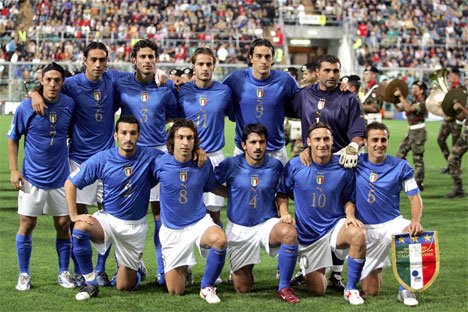
That's what I would call the post-Berlusconi period. Italy has a lot to do to catch up after 5 years of shadows. Economically, politically, culturally it is a bit of a wreck, but that is precisely why we all have to contribute to the Italian Renaissance.
I am optimist, and Italy could symbolically start with a vicory at the world cup!
Serbia & Montenegro, as Srdjan puts it, represents the hopes of the countries that are not there anymore. Italy represents the hope of the countries that are looking for a fresh start: A Renaissance.
Wednesday, June 07, 2006
Serbia and Montenegro: beware of the country that no longer exists
Serbia and Montenegro will still participate as a single state at the upcoming football World Cup in Germany 2006. Serbia and Montenegro has a solid team that ended up first in the qualifications round (in front of Spain). It is important to point out that they conceded only one goal in the entire process of qualifications. Moreover, for the first time in the last 20 years the coach of the ‘national’ team was successful in creating a magnificent team spirit among the players. Despite the fact that Serbia and Montenegro is playing in the so-called “death group” together with Argentina, Holland, Ivory Coast and despite the fact that bookies consider it a total outsider, the chances of this team are great.
Only once in its history Serbia and Montenegro(then Kingdom of Yugoslavia, comprising todays's independent states of Slovenia, Croatia, Bosnia, Macedonia) ended up in the World Cup semi finals (in the very first world cup held in Uruguay 1930). This time this is likely to happen. If not for the statistics and bookies previsions then for the shere fact of the romantics. The triumph of the paradox can take place in Germany. Can you imagine a non-existent country playing in the World Cup finals and possibly winning the Cup? If your team did not qualify, or if you do not have preference in terms of the national selection you would like to support, then you have an appealing option, support Serbia and Montenegro (support Yugoslavia), the country that no longer exists.
Tuesday, June 06, 2006
France and Germany: waiting for Europe
Chirac and Merkl met today to discuss about the future of Europe (laughter). France and Germany would like to re-launch the constitutional process (laughter). This is not the Comedy of Errors, it's the tragic reality facing Europe.
As long as there are leaders like Chirac around, there is little to be hoped for Europe. Chirac was the major loser of the French Referendum on the European Constitution last year? Why is he still there? What does he have to say about Europe?
Even for someone who teaches and follows European law and politics, it is hard to claim that Europe is well and alive. We need a more drastic European discourse, and new faces to represent it.
The next European Council will gather on 15 and 16 of June. Will it be able to raise its voice?
As long as there are leaders like Chirac around, there is little to be hoped for Europe. Chirac was the major loser of the French Referendum on the European Constitution last year? Why is he still there? What does he have to say about Europe?
Even for someone who teaches and follows European law and politics, it is hard to claim that Europe is well and alive. We need a more drastic European discourse, and new faces to represent it.
The next European Council will gather on 15 and 16 of June. Will it be able to raise its voice?
Monday, June 05, 2006
Constitutional Dilemmas
Law is meant to solve conflicts between competing claims. Constitutional Rights are normally considered to be a very efficient tool to achieve that aim.
What if, however, constitutional rights conflict one against another and it is impossible to compare their strength, or to rank them?
This is the object of my forthcoming book with OUP titled Constitutional Dilemmas. Conflict of Fundamental Legal Rights in Europe and the USA. You can learn more about it here
What if, however, constitutional rights conflict one against another and it is impossible to compare their strength, or to rank them?
This is the object of my forthcoming book with OUP titled Constitutional Dilemmas. Conflict of Fundamental Legal Rights in Europe and the USA. You can learn more about it here
Saturday, June 03, 2006
The Rhetorical Steps to War (4)
Tony Blair is seeking the benediction of Benedict.
What for? 'In Mr Blair's last papal audience on the eve of the invasion of Iraq, he explained to the late Pope John Paul II the reasons why he thought a military attack on Saddam Hussein would be morally justified.'
Are we on the eve of the invasion of Iran? The parallel is there for everyone to see and assess. I am only drawing your attention to this fact.
What for? 'In Mr Blair's last papal audience on the eve of the invasion of Iraq, he explained to the late Pope John Paul II the reasons why he thought a military attack on Saddam Hussein would be morally justified.'
Are we on the eve of the invasion of Iran? The parallel is there for everyone to see and assess. I am only drawing your attention to this fact.
Thursday, June 01, 2006
Interviews for the Italian Radio
Recently I gave two interviews for the Italian radio Nova on the question of Ratko Mladic, indicted for war crimes in the ICTY and on the question of independence of Motenegro. Both interviews can be downloaded from the internet. The interview on Mladic, under the title “Radio Senza Frontiere_puntata n. 9” (click on parte2) and the interview on Montenegro under the title, “Nuovi confini nei Balcani: il referendum del 21 maggio visto dal Montenegro e dalla Serbia”.
Subscribe to:
Posts (Atom)