Wednesday, June 07, 2006

Serbia and Montenegro: beware of the country that no longer exists


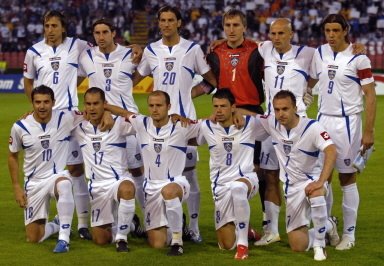
Serbia and Montenegro will still participate as a single state at the upcoming football World Cup in Germany 2006. Serbia and Montenegro has a solid team that ended up first in the qualifications round (in front of Spain). It is important to point out that they conceded only one goal in the entire process of qualifications. Moreover, for the first time in the last 20 years the coach of the ‘national’ team was successful in creating a magnificent team spirit among the players. Despite the fact that Serbia and Montenegro is playing in the so-called “death group” together with Argentina, Holland, Ivory Coast and despite the fact that bookies consider it a total outsider, the chances of this team are great.

Only once in its history Serbia and Montenegro(then Kingdom of Yugoslavia, comprising todays's independent states of Slovenia, Croatia, Bosnia, Macedonia) ended up in the World Cup semi finals (in the very first world cup held in Uruguay 1930). This time this is likely to happen. If not for the statistics and bookies previsions then for the shere fact of the romantics. The triumph of the paradox can take place in Germany. Can you imagine a non-existent country playing in the World Cup finals and possibly winning the Cup? If your team did not qualify, or if you do not have preference in terms of the national selection you would like to support, then you have an appealing option, support Serbia and Montenegro (support Yugoslavia), the country that no longer exists.

Tuesday, June 06, 2006

France and Germany: waiting for Europe

Chirac and Merkl met today to discuss about the future of Europe (laughter). France and Germany would like to re-launch the constitutional process (laughter). This is not the Comedy of Errors, it's the tragic reality facing Europe.

As long as there are leaders like Chirac around, there is little to be hoped for Europe. Chirac was the major loser of the French Referendum on the European Constitution last year? Why is he still there? What does he have to say about Europe?

Even for someone who teaches and follows European law and politics, it is hard to claim that Europe is well and alive. We need a more drastic European discourse, and new faces to represent it.

The next European Council will gather on 15 and 16 of June. Will it be able to raise its voice?

Monday, June 05, 2006

Constitutional Dilemmas

Law is meant to solve conflicts between competing claims. Constitutional Rights are normally considered to be a very efficient tool to achieve that aim.

What if, however, constitutional rights conflict one against another and it is impossible to compare their strength, or to rank them?

This is the object of my forthcoming book with OUP titled Constitutional Dilemmas. Conflict of Fundamental Legal Rights in Europe and the USA. You can learn more about it here

Saturday, June 03, 2006

The Rhetorical Steps to War (4)

Tony Blair is seeking the benediction of Benedict.

What for? 'In Mr Blair's last papal audience on the eve of the invasion of Iraq, he explained to the late Pope John Paul II the reasons why he thought a military attack on Saddam Hussein would be morally justified.'

Are we on the eve of the invasion of Iran? The parallel is there for everyone to see and assess. I am only drawing your attention to this fact.

Thursday, June 01, 2006

Interviews for the Italian Radio

Recently I gave two interviews for the Italian radio Nova on the question of Ratko Mladic, indicted for war crimes in the ICTY and on the question of independence of Motenegro. Both interviews can be downloaded from the internet. The interview on Mladic, under the title “Radio Senza Frontiere_puntata n. 9” (click on parte2) and the interview on Montenegro under the title, “Nuovi confini nei Balcani: il referendum del 21 maggio visto dal Montenegro e dalla Serbia”.

Wednesday, May 31, 2006

Is independence referendum legitimate?


The results of the Montenegrin referendum were confirmed today and became official, thus, the republic became independent and the process of separation of the State Union of Serbia and Montenegro became official.

Independence of Montenegro, inevitable nourishes independence aspirations of other territorial entities across Europe and the World. The representatives of the Basque and Catalan territorial autonomies closely followed the Montenegrin referendum and the political climate evolving around this important event. Kosovo Albanians are hopeful that the independence of Montenegro will facilitate their speedy separation from Serbia and the Bosnian Serbs claim that they have right to vote on the future of the state of Bosnia and Herzegovina.

International law has very little to say on the legitimacy of a particular independence referendum, while constitutional orders of only few countries of the world consider secession a constitutional option.

The international community considers the independence of Kosovo a legitimate option while it has a diverse opinion in the case of the Serbian entity in Bosnia-Republic of Srpska. Looking at the legal arguments strictly speaking none of the two have the right to secede. Kosovo was an autonomous province of Serbia in the constitutional order of the Socialist Federative Republic of Yugoslavia, and as such it did not have the right to secede. Such right belonged only to the Republics. The arguments that Kosovo was de facto granted a status of the republic with the right of veto in the executive body of the ex-Yugoslavia, remains weak in this context. In the case of Bosnia and Herzegovina, the legal argument is similar. However, why is the constitutional order of a undemocratic communist state as the ex-Yugoslavia was, considered as a legal precedent in this case? Could the after Dayton territorial delimitation of Bosnia become legitimate over the passage of time in such a way as to allow the independence referendum for the Bosnian Serbs and Croats? Not now, but in 20 years time, when the current constitutional order of Bosnia becomes not only a legal but also a social and political fact. All these are questions that will be on the top of the political agenda in these countries for the years to come. Independence of Montenegro, whether one wants to admit it or not, will certainly have implications on the case of Kosovo and possibly Bosnia. Montenegro’s independence still found grounds in the legal system of the state of ex-Yugoslavia. In Kosovo, this is clearly not the case. Granting Kosovo independence without the consent of Serbia will be crossing of the Rubicon, and no one could stop the Bosnian Serbs (and Croats) to dissolve the state of Bosnia and Herzegovina. The independence of Montenegro, finally completed the series of legal sucessions of the ex-Yugoslav republics. Going beyond it would mean creating a precedentand a wholy novel legal practice, appealing to many independence movements around the world.

Italian politics: I can't stand it anymore

As many times said before, Berlusconism (Mr B. philosophy) is coming to an end.
On sunday, his party lost the administrative elections by far. He thought he would come back immediately, but the truth is that he's burnt for ever.

Italy is slowly putting itself together after a very distressful period, even if a major constitutional referendum is coming up on June 13. Tha will be the last event of an electoral saga that has shown to the entire world how frustrating can be italian politics.

Tuesday, May 30, 2006

Fallaci's Fallacious Ideas

Oriana Fallaci, an italian journalist living in New York, gave yet another aggressive interview published on the New Yorker.

Originally from Florence, she claims that she'll explode the mosque being built in Colle val d'Elsa, a small town beside Florence. Here's the relevant part:

"She spoke of a new mosque and Islamic center planned for Colle di Val d’Elsa, near Siena. She vowed that it would not remain standing. “If I’m alive, I will go to my friends in Carrara—you know, where there is the marble. They are all anarchists. With them, I take the explosives. I make you juuump in the air. I blow it up! With the anarchists of Carrara. I do not want to see this mosque—it’s very near my house in Tuscany. I do not want to see a twenty-four-metre minaret in the landscape of Giotto. When I cannot even wear a cross or carry a Bible in their country! So I BLOW IT UP!"

I think that it is a very distasteful choice on the part of the New Yorker to let Fallaci speaks as she does. After all, her opinion is not well informed and she is nothing more than a very opinionated journalist. Arguably, she is a famous and courageous journalist, but this does not make her opinion valuable. Also, she was admired in the past as she dreaded power and in particular the personification of power. Noble concern. But yet again, when you demolish power, you still have to put in place something that fills the gaps. A more illuminated authority, or something else. Fallaci fills the gap with unreasoned hatred.

The only reason why it is worth to publish an interview with Fallaci is that her outrageous opinions always increase the number of sells. So, well done New Yorker, you have indeed increased your popularity by selling crap.

Unfortunately, her thin arguments, based on thin air and pure gut (as she says herself), show precisely the lack of ability to communicate deeper and more articulate concerns on the place of religions within our public spheres.

But more importantly, building a mosque is about liberty (religious liberty in this case). Fallaci enjoys the liberty to speak freely, but she would like to restrain the liberty of some other people to practice their own religion. Arguably, she want to restrain only Muslim's freedom.

Why? Just because of hatred and nothing more... or so it seems. Just read the following citation from the New Yorker:

"The magnificently rebellious Oriana Fallaci now cultivates, it seems, the prejudices of the petite bourgeoisie. She is opposed to abortion, unless she “were raped and made pregnant by a bin Laden or a Zarqawi.” She is fiercely opposed to gay marriage (“In the same way that the Muslims would like us all to become Muslims, they would like us all to become homosexuals”), and suspicious of immigration in general. The demonstrations by immigrants in the United States these past few months “disgust” her, especially when protesters displayed the Mexican flag. “I don’t love the Mexicans,” Fallaci said, invoking her nasty treatment at the hands of Mexican police in 1968. “If you hold a gun and say, ‘Choose who is worse between the Muslims and the Mexicans,’ I have a moment of hesitation. Then I choose the Muslims, because they have broken my balls.” "

Is it worth to read the whole interview? I REALLY DO NOT THINK SO! It would simply increase the number of visitors of the New Yorker website. But you would not learn anything in particular, if not that it is possible to hate on a grand scale. My first gut reaction to her interview was to hope that someone blow her up, just as she would like to do with the mosque in Colle Val d'Elsa. After all, we all have gut reactions, and that is good. What is horrendous is to pretend that gut reactions are the way forward, a sort of illuminating solution to all the evils in the world.

Hatred, whatever its source, is only a source of evil. Let us simply hope that by airing it publicly it will be dispersed as any bad seed. If it were to germoliate, that would be sad, as sad as Oriana Fallaci

The US as "Failed State"

A quick link to an interesting article by Chomsky in todays Independent, an excerpt from (yet another) new book. In many ways, it is fairly standard Chomsky polemic, provocative and one-sided, and covering such a wide array of topics and incidents to make it practically impossible to summarise, or, indeed, engage with in any sustained critical manner. This is emphatically not to say, however, that Chomsky's writings in this regard are worthless; on the contrary, they perform an essential balancing role. It is, however, to my mind important to recall that things are rarely as black and white as he presents them (or that, even if they are in the final instance, his manner of presentation is unlikely to do more than preach to the converted).

Several interesting passages, however, including on the surprising reulsts of the US attempts to introduce democratic elections in Iraq and in Palestine, and also in terms of the Cuban role in the aftermath of the earthquake in Pakistan in 2005, and the role of Venezuela in rejuvenating the economies and politics of Latin America. Also noteworthy is his main claim, that the US displays the three basic characteristics of a 'failed state': unwillingness to protect their citizens from violence; a tendency to regard itself as 'above the law'; and a lack of democracy, either in terms of the basic institutional forms, or of a deficit between the output of those forms and the will of the general public. It is in the last point that Chomsky makes his most forceful argument of a striking incongruity between public opinion and public policy in the US, with many crucially important Government actions apparently standing in stark contradiction to what the majority of citizens actually want.

Like I said, pretty standard Chomsky; and this alone means that it's very much worth a read...

More Fragmentation of International Law? ECJ rules out Irish claim before ITLOS

The ECJ has today ruled that an attempt by the Irish Government to bring the UK before the International Tribunal for the Law of the Sea (ITLOS) over the Sellafield nuclear plant is in breach of EU law, on the grounds that only the Union institutions have jurisdiction of such claims between its Members. The Court has apparently held that, as the UN Convention on the Law of the Sea (UNCLOS) has been incorporated into EU law, the Irish action before ITLOS - which focuses on the Mox plant, designed to import and reprocess foreign waste - is illegal, as it fails to respect the its own exclusive jurisdiction over the case.

This was not unexpected. The Arbitral Tribunal set up to hear the Mox case noted as early as 2003 (see its Order No. 3 here) that it could not proceed with an examination of the merits until the question of exclusive EU competence had been decided; and it seemed entirely prepared to leave this decision to the ECJ (see para. 26). Even though neither the UK nor Ireland had argued before it that all interpretation of the Convention falls entirely under the exclusive jurisdiction of the ECJ, the Tribunal found that "it cannot be held with certainty that this view would be rejected by the European Court of Justice" (para. 21); and both parties were in agreement that, should this happen, then the Arbitral Tribunal set up under the UNCLOS would have no jurisdiction to hear the case.

The judgment is not yet available online, and it will certainly be necessary to read it closely before drawing any hard conclusions from it. It does, however, seem significant in more general terms, for those (such as, for example, the International Law Commission) concerned with the fragmentation of international law, and in particular with the fragmentation of those judicial bodies competent to rule on it. It is clear that this ECJ judgment paves the way for the possibility that the same Convention may well be subjected to final and binding interpretations by two different bodies, with potentially differing views, depending on which states are parties to any given dispute. It is thus easily conceivable that the same words of a legal instrument could give rise to two substantively different sets of obligations, depending on not what, but who is at issue. It is difficult to see, in these terms, how this decision of the ECJ can do anything but undermine the push towards the creation and enforcement of coherent and consistent global standards; and this in perhaps one of the most important areas of this endeavour, the responsibility for transboundary nuclear pollution.

Monday, May 29, 2006

29 May: the failure of the European Constitution

Today 29th of May is the anniversary of the failure of the European Constitution. One year ago, France voted No to the referendum and triggered a European crisis of 'consitutional' dimensions.

The real patient is not Europe as a supranational entity. Nation States are the ones in the worst state of health. Starting from France and ending with Britain.

France is the most obvious example. The referendum merely catalysed the downfall. Chirac and the right wing have gone through a very troubled period (suburbs, students, clearstream etc..). What is surprising is the fact that the left wing is unable to profit out of that failure. The reason is that the left wing who voted No to the European Constitution committed suicide.

They thought they were smart. The reality is that they do not have a clue of what to put in place of what they criticised. This is a gigantic sin. By giving up a hope of institutional improvement (not massive, though improvement), they legitimazed the status quo.

They probably did not know how horrible is the status quo. France as a nation state is dying and it prepares itself to die in the most spectacular way. Just as it did in 1789.

Saturday, May 27, 2006

The Rhetorical Steps to War (3)

Proposition 1: Blair and Bush acknwoledge mistakes in Iraq
Translation: Blair and Bush are now experienced war-mongers and they will prove so in Iran

Proposition 2: Tony Blair signal need for stronger UN!
Translation: Tony Blair wants the power to act pre-emptively

Friday, May 26, 2006

Neverending tension in Italy

Elections are bad for a country. This is the superficial message that one could gather by observing Italy at this very moment. On Sunday, 20 millions people will vote for the administrative elections. The cities of Milan and Naples are the most prestigious posts on offer.

But the problem is that the nasty climate of the political elections has been extended thus far, making it unbearable. A very good illustration of the less-than-civilized climate is given by the Bindi's case.

A (fascist) senator thought it appropriate to label a new minister as 'a lesbian.' His party members had to apologize on his behalf; his party leader called him 'imbecile.'

Where are we going?

Wednesday, May 24, 2006

Iran seeks US talks: The Rhetorical Steps to War? (2)

It seems that I may have underestimated the significance of the Iranian President's recent open letter to the Whitehouse. Until very recently, any contact at all with the US was viewed as taboo by the hardliners in the government, and the provocative, even at times offensive tone and content of the letter is perhaps best understood as an attempt to soften the blow domestically rather than increase it internationally. It seems to have worked: a number of leading conservative figures in Iran have publically endorsed the letter.

Now it has been followed, according to the Washington Post, by a request by the Iranian government for direct talks with their US counterparts over their nuclear programme; one European diplomat is even quoted as saying the Iranians are "desperate" to get around the negotiating table with "the Great Satan". This is clearly a significant ratcheting down of the level of rhetoric that we have seen before, and makes it appear that those analysts who insisted that the content of the letter was less significant than its return address were, in fact, correct: it now seems like it was an opening invitation to treat, regardless of how it was phrased.

So what has caused this volte-face? The Post suggests that it is fear of sanctions, coupled with strong Iranian public support for re-establishing some form of contact with the US. However, given the public stances of both Russia and China on the issue, official Security Council action seems some way off. Indeed, this move comes shortly after the Russian President Putin made his remarkable attack on the US, likening it to a "wolf" that simply "eats and listens to no-one"; and the Independent is today reporting Russia's increasing displeasure at US plans to build a range of bases in Europe to protect the West against any Iranian nuclear attack. Developments such as these seem to make concerted UN Security Council action much less likely; so why is Iran choosing now to make such, if not actaully conciliatory then at least potentially so, moves.

An unpleasant thought, certainly from the perspective of an international rule of law: is it less the immediate threat of sanctions, and more the knowledge of what the US is prepared to do if it can't bend the Security Council to its will? The Iranians may well come to feel that the checks and balances of the UN, however imperfect, are infinitely preferable to what the US has already shown it feels to be the only alternative to a paralysed Security Council.

Monday, May 22, 2006

Literary Suggestion

Just bought Philip Roth's last book 'Everyman', and quite excited about it.
Roth is the best writer alive, and captures as nobody else can the tragedy of life and death in our contemporary world (America in his case).

Sophocles and Shakespear are two other examples of that ability to grasp sublime tragic moments.

For a very recent review, please have a look at the New York review of Books, here.

Friday, May 19, 2006

Committee Against Torture on US Report

The UN Committee Against Torture has released its response to the US report filed under Art. 19 of the Torture Convention. It can be read in full here or see the BBC's summary here. A couple of interesting points:

- At para. 7, under the heading of "positive aspects", the Committee "notes with satisfaction the State party's statement that the United States does not transfer persons to countries where it believes it is 'more likely than not' that they will be tortured". This does not seem to set the evidential threshold for the non-refoulement clause of Art. 3 particularly high, and certainly lower than the "substantial grounds for believing"that there is a danger of torture if returned, which is the actual wording of the text. (On this point further, see the Committee's General Comment 1, in which it notes that the risk must go beyond the level of theory or mere suspicion, but that it "does not have to meet the test of being highly probable").

- At para. 13 - the Committee reiterates the need for a federal statute outlawing torture, despite the US's claims that all of its obligations to criminalise conduct under the Convention are already met by existing federal and state statutes. It also regrets that "despite the occurence of cases of extraterritorial torture of detainees" no prosecutions have been initiated under the extraterritorial criminal torture statute.

- At para. 14 - the Committee rejects the assertion by the US that the Torture Convention is not applicable in times of war, and that the "law of armed conflict" exclusively prevails. Only really surprising thing here is that this was even suggested.

- At para. 15 - the phrase "territory under the State party's jurisdiction" includes those areas over which they exercise de facto control; again, not particularly surprising, and the US Courts seem to be moving in this direction in terms of Guantanamo.

- At para. 17 - the Committee "regrets" the US response of "no comment" to the allegations of secret detention facilities in which detainees are subjected to cruel, inhuman and degrading treatment. All acts acts of intelligence gathering also engage the full international responsibility of the state.

- At paras. 20 and 21 - concern is expressed here about the fact that the US does not view the prohibition of refoulement as applying to detainees outside of its territory; perhaps most interesting here, however, is the recommendation on diplomatic assurances: "the State party should only rely on "diplomatic assurances" in regard to states which do not systematically violate the Convention's provisions, and after a thorough examination of the merits of each individual case". This may well be important in the context of the upcoming case in the UK, which I discussed here.

- At para. 22 - The Committee calls explicitly for the closure of Guantanamo Bay.

- At para. 24 - clarification (for those who needed it) that "water-boarding", "short shackling", sexual humiliation and the like are indeed forms of cruel, inhuman and degrading punishment, and hence outlawed under the Convention.

- At para. 40 - The Committee here invites the US to reconsider its decision not to become a party to the ICC.

These are, to my eye, the interesting international law-related passages. There are of course, many others, such as condemning the use of torture in Iraq and Afghanistan, calling for proper education and training of military and law-enforcement personnel, treatment of women and children, and calls to reconsider the certain devices and methods of execution. In terms of the last of these, what is perhaps most striking is that the Committee calls only for a reconsideration of the methods, and not the fact itself, of execution.
EU Parliament on "Human Rights in the World 2005"

Interesting just to note that the European Parliament's recent annual report on human rights, authored by the British Labour MEP Richard Howitt, has criticised the UK government for its failure to sign up to certain basic international human rights instruments; including the Migrant Workers' Convention and, perhaps more surprisingly, the Council of Europe's anti-trafficking convention and the Protocol to the Convention on the Rights of the Child on the involvement of Children in armed conflict. There is some praise to, however, for the UK's stance on the death penalty during the period of its Presidency.

The report suggests "EU activities in the UN with respect to human rights are too introverted" (para. 27), regretting in particular the Union's failure to sponsor resolutions condemning human rights violations in China, Chechnya and Zimbabwe; further, in a section (para. 23) that seems particularly loaded in the light of the Mohammed cartoon controversy, the Parliament

Specifically reminds the Council and the Commission that most human rights abuses would be impossible in countries with stronger traditions of freedom of speech and press freedom; therefore calls on the Council and the Commission to emphasise this key point as strongly as possible in all political dialogues, as in the case of development and trade policy.

On the subject of the ICC (para. 32), the Parliament has some reasonably strong words for the US: it

Calls on the US Administration and the Congress to end the delay and ratify the Rome Statute establishing the ICC; considers that no legal exception can be made for the United States on this point; condemns the fact that certain countries, including a number of EU Member States, have entered into "bilateral agreements" with the United States granting de facto impunity to US soldiers.

Another interesting element is the relatively tame level of rhetoric reserved for Iran (para. 37), despite the dismissal by the latter of the EU's latest compromise proposals as like offering "walnuts and chocolates" to a four-year-old child. The Parliament responds by condemning

... the Iranian President's call for Israel to be wiped off the map; expresses its concerns about the human rights situation in Iran and... expresses its regret at Iran's poor human rights record during the first six months of President Mahmoud Ahmadinejad's term of office...

Also noteworthy is their concern that current migration measures within the EU do not in practice allow for its international obligations in terms of refugee law to be met (para. 98). That's my impression of the most interesting bits, after, admittedly, a very quick skim. There's probably other stuff in there, but it is, after all, only the Parliament speaking; they do, at least, have the good grace to concede that their own interventions in terms of human rights "could be rendered more effective in a number of ways"...

Thursday, May 18, 2006

The Journal of Philosophy of International Law

For all those interested in Law and Politics in International law and beyond,
here's a new journal published online: The Journal of Philosophy of International Law.

The editor in chief is my colleague at Aberdeen Law School, Prof. Tony Carty. . This is an electronic journal, only accessible on the web. I particularly welcome the growth of e-journals as they allow a more speedy diffusion of ideas and spare the costs of printing. After all, all we should care about is the quality of scholarship. The quicklier it gets circulated, the better.

On the eve of the Montenegrin Referendum: explaining the ambiguities


1. The grey zone: The European Union imposed a condition on the Montenegrin referendum procedure. Namely, in order for the independence vote to be successful 55% of those who vote will have to support this option. If the independence vote ends up being between 50% and 55%, Montenegro could legally not become independent but the factual situation will be such that more people voted for independence than for the joint state. Montenegrin government was not happy about this condition but was forced to accept it. The argument for imposing such qualified majority requirement was partially based on comparative legislature, partially on the conviction that deciding on the independence of a certain territory or administrative unit will have to be based on the support of the largest possible portion of the population in order to assure a stable and united future for the country, in both cases. Such condition, imposed by the EU, proved to be the right one, also because it managed to make all political options participate in the referendum procedure. Why is then the Djukanovic’s government insisting on the political construction of the grey zone? In this way Djukanovic is creating himself more space for political manoeuvring. He is threatening to severe Montenegro’s relations with Serbia and withdraw all Montenegrin political appointments and administrative staff from federal institutions. Simply, the Montenegrin government could continue to behave as if Montenegro were independent and ignore EU’s demands for the construction of a more functional federal state. This is, however, less likely. The grey zone is an escape goat for Djukanovic, in this way he has some chance of presenting himself as a winner in the referendum, at least until the September parliamentary elections. Winning less than 50% would mean an end of the political career of Milo Djukanovic, last of the old ex-Yugoslav, ex-Communist nomenclature.

2. High voter turnout: The higher the voter turnout, the more difficult will it be for Montenegro to go independent. Paradoxically, strong campaigning for independence will cause more people to vote regardless of their preference in terms of the future of the Montenegrin state. On the other hand, Djukanovic could not allow himself not to campaign. There were rumours (and some vide footage) that the government is temporarily buying off the identity cards from the members of the unionist block in order to prevent them from voting and in order to decrease the voter turnout, but it is rather uncertain that this illegal practices could have an important impact on the final exit of the vote. This time, there is a greatest number of registered voters in the democratic history of Montenegro. This is not a good sign for Djukanovic. Few will decide to do something else on the day of the elections, if the voter turnout reaches what now seems the impossible 90%, everything can happen. In this case even the impossible scenario in which the independence vote would remain below 50% remains an option.

3. We love you but we want to leave and be the masters of our own destiny: This is the winning formula for the Montenegrin independence and the Djukanovic’s political block is strongly using this political rhetoric. Namely, the vast majority of the Montenegrin population feels strongly related to Serbia and their common Serbian culture. Many Montenegrin citizens live and work in Serbia or have close business ties with Serbia. On the other hand, the bad memory of Milosevic’s years, the impression that the union with Serbia carried in itself a heavy price of the years of isolation, bad economic situation etc., makes many more prone to vote for independence. Yet, the fear of the severing of the relations between the two states in the case of Montenegrin independence might just make them opt for the joint state. It is for this reason that the tones in the independence campaign lately became more moderate, “we will go independence but everything will remain the same”, “when Montenegro becomes independent first foreign capital that I would visit would be Belgrade, said a Montenegrin foreign affairs minister”. Will everything remain the same? Probably yes, but people wonder. The fact that Djukanovic often used radical political rhetoric to support the independence option certainly did not help his cause.

4. Bosniak voters: Seemingly, the Bosniak Muslim population living in Montenegro will vote for independence. Djukanovic’s regime was always more tolerant towards minorities than Milosevic’s. While the Albanian minority in Montenegro will surely vote for independence, this is not so certain in the case of the Bosniaks. Bosniak political parties participating in the government at the national and local level in Serbia were actively involved in the campaign for the joint state and this can have an important political impact on the result of the Montenegrin referendum. Namely, the area in which the Bosniaks live, Sandzak, lies in the south-west of Serbia and in the north of Montenegro, splitting this region in two in the case of Montenegrin independence would certainly not favour the local business and personal relations (this is especially true in the case of initial cold inter-state relations between Serbia and Montenegro.

Wednesday, May 17, 2006

Prodi presents his team today

The italian executive does not start very well.
The number of ministers has increased, which means a lowered accountability.
The number of women is not very significative (only 25%)
The nature of the executive is highly political and biased toward radical left
rather than a more reformist left.

Reforms are the daily bread Italy is craving at the moment, so let's hope that this team will be able todeliver on so many crucial political points.