Tuesday, August 01, 2006

Lebanon 2006-Respect for Humanitarian law vs. right to exist

On 12 July 2006 in the morning Hezbollah, Iran and Syrian sponsored terrorist organization used the territory of Lebanon to attack Israel’s territory and its army, sever soldiers were killed and two abducted. Israel attacked mounting bombardments an ground offensive on Lebanon that for the moment counts more than 500 civilian victims. Hezbollah on its own part continues to counter the humanitarian norms of international law by continuous launching of inaccurate missiles into the territory of Israel. We are currently facing numerous potential conflicts related to the situation in Lebanon, first and most obvious conflict between Israel and Hezbollah and Israel and the Lebanese army, second diplomatic (although uneven) tug of war between the US and certain EU states over the strategy for the resolution of the conflict, thirdly a conflict between the terrorist organizations over popularity in the Arab World, Al Kaeda seem to feel its popularity being under threat vis-à-vis Hezbollah, fourthly conflict between the Suni Arab World (Saudis, Egypt) and Iran and Syria etc.

Antonio Cassese, a prominent Professor of international law, and an ex-judge and President of the International Criminal Tribunal for the former Yugoslavia (1993-2000), in an article, “Beyond every legal principle”, published in the print edition of the Italian daily newspaper “La Repubblica”, analyzes the situation in Lebanon from the point of view of international law and gives a generally interesting twist to the debate on the present conflict in this country.

Cassese writes, that in normal circumstances, attack on the border patrol of one country from a territory of a neighbouring country would require immediate negotiations and the state from which the attacks occurred would have to immediately act in order to repatriate the hostages and to conduct a thorough inquiry to punish the guilty party. Israel’s immediate bombardments of Lebanon, were nevertheless justified because, in the case of Lebanon, Cassese writes, the actions of Hezbollah do not represent actions of a State, “but came from Armed Forces that operate in Lebanon escaping the control of the Lebanese government. Therefore it would not have served anything to demand from the authorities of Beirut the repair the damages inflicted by the illicit acts.” Yet, Cassese adds, initial justified reaction of Israel, went beyond the rules of international humanitarian law.” Then Cassese carries on to name several incidents in which Israel tried to justify each of its actions while bombarding Lebanon (e.g. bombarding of the Beirut international airport was necessary in order to prevent Hezbollah receiving more arms etc.) These justifications are not convincing for this eminent Italian jurist, he says, “if a singular military operation may appear justified, the ensemble of actions exposes the radical disproportion between the evident aim (to place term to the attacks of Hezbollah and to obtain the restitution of the hostages) and means used (the immediate destruction and on immense scale of all the Lebanese infrastructure, with most serious effects on the civil population). For Casssese, and most of the ‘international community’ bombardments of Cana and the murder of children is undoubtedly an example of such excess.

On the other hand, Cassese obviously does not seem close to the political sensibility of Giuliano Amato, his colleague professor and Italian Minister of the Interior and ex-Prime Minister, who argued that it is absurd to talk about proportionality, “as if we were talking about accountancy and not about the survival of a state [hinting at Israel].” (according to Cassese’s commentary) In another article in the Italian daily Corriere Della Sera Amato argued similarly, “Israel is, for nth time in the history, facing the same troubles, to know itself surrounded by enemies who deny its right to the existence ".

Facing the probability of sending a massive international peace keeping force to South Lebanon, Amato’s arguments seem weak. However, facing the low probability of mounting an effective (politically and militarily) international force, it can be argued that Israel has the right to be worried (which still does not justify the excessive victims caused by the collateral damage of Israeli bombings).

Arguably, if effective, this international force would also, to a certain extent, contribute to the feeling of security of the state of Israel. It is for the moment politically unrealistic but worth considering of sending such a force on the divisive line between Israel and Palestine, such a solution would not be without benefits for the people of Israel. Israel’s politicians are sceptical, they are asking for more time and they seem to be ready to accept international involvement only if NATO (read the US, not the UN) plays the leading role in this.

Recent Italian attempt to reach an international agreement on resolving the present Middle Eastern Crisis for the moment failed. American administration still seem reluctant (although the situation is changing) to put the pressure on Israel to accept the terms offered by some other international actors. Today the Council of the European Union met to discuss the situation in Lebanon and there is a likelihood that some agreement, amongst other thins, on the international force will be reached. Simultaneously, in the US, a prominent Republican Senator Hagel in an eloquent speech, challenged President’s current stance on Lebanon, urging President Bush to turn all U.S. efforts toward "ending this madness," and calling for an immediate cease-fire in the Mideast.

Numerous US based think tanks seem to be critical of the US lenience towards Israel, among which International Crisis Group in its brand new report “Israel/Palestine/Lebanon: Climbing Out of the Abyss” and the Brookings Institution.

It remains unclear how can this international force be constituted (will US be playing a significant role in the military contingent – which seems extremely unlikely bearing in mind the current situation of extreme global military overstretch) and what are the prospects for Hezbollah agreeing to international demands to accept the Lebanese government's authority and begin the process of disarming? Can the conflict between the Palestinian Authority and Isreal be resolved in a simmilar manner?

The Judge (Emperor) is Naked!!

Jeremy Waldron reviewed Ronald Dworkin's latest book Justice in Robes on the New York Review of Books. (you can only access it in full if you're subscribed).

It is not a particularly good review, which probably mirrors the fact that it is not a particularly good book. The usual Dworkin, but this time much more aggressive towards its critiques. Posner, Rorty and others are vigorously (if not violently) treated and the argument does not benefit out of it.

The only interesting piece is an article on value pluralism in response to Isaiah Berlin. Dworkin attempts to play down value pluralism, but he is not quite convincing. Especially not so when he concludes in the end that it is better to hope that the sacrifices predicted by value pluralism could be avoided. We all hope that no sacrifices are necessary to live together in a harmonious society. But, the hope is very thin and should not disguise the necessity of some trade-offs. In particular that hope should not prevent us from understanding when and how to deal with sacrfices of value.

The end of Castro?

The news that Fidel Castro, 'lider maximo' of Cuba, has handed to his brother the power because of a health problem has been met with different reactions.
Le Monde simply says that this is an interim situation, while the italian Corriere della Sera emphasizes the possibility of a more permanent move. The New York Times, underrates the news by referring to a temporary problem.

Given that Castro is 80 years old and his health seems to be worsening, it would be interesting to imagine a post-Castro scenario. Would his brother command as much authority as Fidel? Would the expats go back to Cuba if Castro died? Would the regime change? I believe we'll know more about this fairly soon.

Wednesday, July 26, 2006

Berlusconi's Surprise Party

Zorro Berlusconi dances masked in Morocco for his wife. Our national arlequin found yet another disguisement. Many think that he could have been a great show man, many think he is. Read here for more details on the 'genius' of entertainment.

Monday, July 24, 2006

Apologies to our readers

Due to summer holidays, we decreased the number of our postings.
We'll be back soon with plenty new insights!

Please keep visiting us

Wednesday, July 12, 2006

Should the U.S. Welcome a More Assertive Japan?

Despite the extensive coverage of North Korea’s missile tests last week and the responses of the various concerned countries – the E.U., U.S., Japan, China, Russia and South Korea - an important aspect of this story remains unexamined. The media has covered Japan’s tough reaction to the tests - it has proposed a U.N. resolution that would impose sanctions upon Pyongyang and publicly pondered the advisability of pre-emptive strikes against North Korean missile launch sites – and subsequent Chinese and South Korean criticism of Japan. However, the growing public popularity of a more assertive Japanese foreign policy, and the politicians who espouse it, has been largely ignored. This is an important development from the American perspective and one that deserves closer analysis. Almost immediately after the end of World War Two American policy makers recognized the need for a rehabilitated, strong Japan to serve as a counterweight to Soviet power in Asia. Thus, even as they oversaw the writing of the Japanese Constitution, which includes the famous Article 9 forbidding war or the threat of force in international disputes, U.S. policy makers began pushing Japan to be more assertive on security issues. American encouragement of a bigger Japanese role in the East Asian security scene, and Japanese rejection of such a role, is a central theme of U.S.-Japanese relations over last 60 years. President Bush, like his predecessors, has pushed Tokyo to play a more active role in international security. He gained an important, if largely symbolic endorsement of this stance from Japanese Prime Minister Junichiro Koizumi in 2003 when Koizumi convinced the Japanese Diet to allow him to send an essentially non-combatant contingent to Iraq. This marked the first time that Japan sent troops abroad since 1945. Now, nationalist politicians are using the Japanese public’s hostility toward North Korean (which has, amongst numerous unneighborly acts, abducted a number of Japanese citizens over the years) to garner support. Chief amongst these are the popular Tokyo Governor Shintaro Ishihara, Japan’s most famous nationalist, and Koizumi’s chief cabinet secretary Shinzo Abe, widely considered Koizumi’s likely successor, who made his career largely on his hawkish stance toward North Korea. Abe and rival Taro Aso, the Foreign Minister, raced to be the first to condemn the missile tests last week. To the Bush administration this growing foreign policy assertiveness, especially on North Korea, must seem like a boon. However, while Washington will probably welcome this tougher approach from Tokyo, it should recognize the complications that will accompany such a change. That China and South Korea seem as nervous about Tokyo’s response as they do about North Korea indicates the deep historical cleavages that influence foreign relations in East Asia. Japan’s wartime atrocities in China, South Korea and elsewhere are common knowledge. However, less understood is the fact that the Japanese, unlike the Germans, despite their pacifist image, have failed to fully examine and acknowledge their forebears' World War Two behavior. Aside from the annual media coverage of Japanese Prime Ministers visiting Yasukuni Shrine (which honors, amongst many others, 14 men executed for war crimes), most foreigners fail to grasp the depth of the problem. This is highlighted by the fact that Ishihara, Abe and Aso, all successful politicians, have all made statements about Japan’s role in World War Two that would be career-enders for any German politician. It is not accidental that, despite close economic and cultural ties, Japan’s relations with China and South Korea are barely civil. With the growing popularity of nationalist politicians and public acceptance of their rhetoric (and presumably policies) on many issues, U.S. policy makers need to account for the increased friction that seems likely to accompany Japan’s more assertive foreign policy. After all, the relationship with Japan is the central component of Washington’s security policy in East Asia. The U.S. itself has complex, often troubled relations with China and South Korea and it does not need the added burden of worsening relations between them and Japan. If Japan continues to embrace a more assertive, nationalistic foreign policy, Beijing and Seoul will react sharply. Mediation by the U.S. – the linchpin of East Asian security relations – will require intensive diplomacy to bridge differences between Japan and its neighbors. Unfortunately, such engagement is unlikely from a Bush administration occupied with other problems and not especially adept at bridge-building . Look for rougher waters in East Asia in the next few years.

Tuesday, July 11, 2006

Democratization of Sovereignty

"With our blood we coloured the soil, with our bones we marked the borders. Around the Church lie the tombs of 25 Serbian Heroes of the Kolubara battle 1914."

Montenegrin referendum demonstrated that peaceful secession through a democratic process can be a realistic alternative to the separation or unification of states through the agreement of political elites or to violent secession through war. The same could occur in the Serbian breakaway province of Kosovo and Metohija, although it is uncertain of what the eventual outcome of its independence will be? Invoking the principles of international law the Serbian government defends a strong and legitimate position that an imposed independence of Kosovo remains unacceptable.

Can the processes in the Balkans trigger similar developments in the rest of Europe and the world? Autonomous provinces of Spain, just to offer an example, looked with great interest at the events of the Montenegro referendum and it is not excluded that some time in the future constituent parts of EU member states might ask for independence.

The European Union, it can be argued, possibly represents a safety niche that can accommodate such independence claims without disrupting the political stability of these countries. As to whether this is possible in other areas in the world, one should be extremely sceptical, since we are still living in the era where nation states have absolute power and beyond the nation states individuals have very little rights. Borders still matter very much and embarking on a project of democratization of sovereignty is very dangerous outside of the context of the European Union. Independence claims of any territorial entity must be resolved taking into account the interests and political stability of the larger state from which it wishes to secede. Internal enlargement might play the role of a compromise solution but this is unfortunately realistically conceivable (in the long run) only within the boundaries of the EU, nowhere else.

Monday, June 26, 2006

The Greatest Alibi: Serbian Radical Party

Recent opinion polls in Serbia demonstrate a sharp rise of the populist, ex-Milosevic ally, Serbian Radical Party. To be more precise, the popularity of all major parties is in decline (including the Radicals), why Radicals demonstrate growth is because they have a more disciplined base that is less likely to abstain on future parliamentary elections, and an increasing number of the Serbs who is pro-European oriented, who decide to abstain.

A recent article in the Serbian daily Blic tries to offer an answer to such political situation in Serbia. Answering the question, I paraphrase, why do Serbian voters have enough, Slobodan Martinovic says,

“Because the democratic block of parties in Serbia demonstrated that power serves only for fulfilling their own personal needs: employment, personal wealth etc. In one word: Pure egoism. Me and once again me.

Because the political elite has no vision of the future, no courage and honesty to face the major problems in the country.

Because everything is the same as before 5th October [5/10/2000 The downfall of Milosevic] Who was powerful then, still is, who employed its children then, still does, who was unemployed then, is unemployed now.

Because they were not honest in their intention to create a normal and stable country. Everything around here is pure improvisation.

Because my friends with whom I fought for a better tomorrow betrayed me. They needed me only in order to come to power, then they forgot me.”

This emotional account to a large extent describes the frustration of many of the Serbian voters. It can be even provocatively argued that the Serbian Radical Party presents the greatest possible alibi for the largest part of the block of pro-European parties in Serbia. Now they can at least say, vote for us, because if you do not or if you abstain Radicals will win. Without the populist, chauvinist and corrupt, ex-Milosevic ally, Serbian Radical Party they would have no excuse any more they would have to explain what they did to assure Serbia’s speedy integration into the EU. They, with no exception, would have a hard job explaining their positive role.

Monday, June 19, 2006

Election Year Politics, American Style

It is only June, but American politicians are already acting with an eye to November’s mid-term elections. Everyone knows that looming elections can cause funny behaviour in American politicians, but Presidential and Congressional conduct has been bizarre even by American standards this year. Take, for example, President Bush’s recent re-discovery of a favourite issue of social conservatives, a push to amend the U.S. constitution to ban same-sex marriages. The measure, which Republican leaders have periodically resurrected over the last few years whenever they feel the need to reinforce their standing with social conservatives, has no chance of gaining the necessary two-thirds majority in the House and Senate and then approval by three-quarters of the states. After a series of speeches to generate sufficient press coverage and mollify social conservatives, Republican leaders will surely abandon the issue until the next time they need to rally their base. Seeking to rally liberal opposition to the measure in his bid for the Democrats 2008 Presidential nomination, Senator Russ Feingold stormed theatrically out of a Senate Judiciary Committee meeting last month after scolding Committee chairman Arlen Specter. A similar issue that commands broader support is the proposed amendment, recently approved by the Senate’s Judiciary Committee, to protect the American flag from “desecration.” Even some members of the Democratic Party, who can usually be depended upon to oppose such silliness, have supported the idea, eager to shed the image of Democrats as out of touch with mainstream Americans. Democratic Senator Dianne Feinstein supported the measure, and Democratic Senator Hillary Clinton recently co-sponsored a similar measure. Congressional debate regarding more vital issues has been no less circus-like. The issue that seems to elicit the most concern from voters centers on so-called “border security,” with most conservatives advocating harsh treatment for illegal immigrants and complicit American employers Many others support more moderate measures, like various amnesty plans that would provided paths to citizenship for many illegal immigrants. However, even these moderate plans have ridiculous elements to them, like President Bush’s call for stationing 6,000 National Guard troops along the U.S.-Mexican border, an absolutely useless - but not costless - gesture. The apex of this silliness came in April when the Senate voted to divert $2 billion from funding for operations in Iraq to programs concerned with halting illegal immigration. There are no coherent proposals on how to use this money, but in an election year, it is the gesture that counts. Iraq was the focus of perhaps the weirdest Congressional spectacle, recent non-binding votes in the House and Senate engineered by Republican leaders that rejected any sort of timetable for withdrawing American troops from Iraq. While these votes were relatively harmless wastes of time and money designed solely to embarrass Democrats, more troubling is the decision, yet again, to fund operations in Iraq “off-budget.” This accounting manoeuvre, which in effect allows Congress to write a massive check but to defer payment to a later date, is becoming habitual with Congress and highlights the growing budgetary problems the U.S. faces. Despite this extensive list of political absurdity, the idealist within me demands that I end with a tribute to a politician who appears to take the idea of public service somewhat seriously. Arlen Specter, the senior Republican Senator from Pennsylvania, has embarked on a lone, quixotic crusade to force the Bush administration to publicly explain their Orwellian domestic surveillance program. Americans seem largely unconcerned or unaware of this program – the Bush administration’s claim that is it necessary to “fight terrorism” has been, once again, sufficient to extinguish latent Congressional and press criticism. This endeavour is not earning him points with conservatives, but it is heart-warming to see at least one politician determined to serve the public interest, even in an election year.

The King of Italy aka the King of the Banana Republic

Emanuele di Savoia left Italy just after the WW2. Italy opted then for the Republic and sent the King away.

Two years ago, thanks to Berlusconi, the ex-King of Italy was allowed to come back.
Today, he is in prison. Perhaps this shows that no matter what you do, or who you are, corruption is endemic in Italy when you have the right (wrong?) connections.

Le Roi est mort...Vive la Republique

Thursday, June 15, 2006

New Ranking of UK Law Schools

Just published on the Times Good Universities.
Have a look here

Interestingly 5 Scottish law schools made it to the best 20. Aberdeen Law School, my place, is number 5, just after Cambridge, Oxford, LSE and UCL.

Tension between US and Italy regarding unresolved Calipari Case

The new Italian government pretends more collaboration from the US as regards the mysterious case of Nicola Calipari, shot in Iraq by American soldiers.

D'Alema will meet Condi Rice to discuss about this issue soon. The Corriere della Sera reports that: "At the present time, Lozano is accused of attempted murder without specific aggravating circumstances. In the charges filed, the public prosecutors underline “the conclusions of the experts and the detailed report from which it emerges that the vehicle was moving at a fitting (permitted and suitable –Ed.) speed for the area and in any case not in a manner that could be perceived as “hostile”, and that the said vehicle should be fired upon, which reconstruction shows occurred at the same time the target was illuminated, not only exceeds the rules of engagement, but goes far beyond them”. The magistrates further underline that “no evidence has emerged in support of the putative justification for the incident, based on excusable error (illegitimate use of weapons or legitimate defence), that could led to a ruling that there are no grounds for action”.

The Age of Penelope: Sicily 2006


-Do you see the graffiti of the obscenity (male reproductive organ) on the bus next to us-asks the old man sitting in the Public Transportation bus of the Municipality of Siracuse, Sicily.

-Yes-responds a confused tourist.

-It is not some hooligans who are doing this, it is the actual bus-drivers-claims the old man.

-Do you know who is Penelope?-asks the old man.

-No-responds a confused and by now embarrassed tourist.

-My god!-cries the old man and then engages in a lengthy explanation-Penelope is the wife of Ulysses from the Greek mythology. Ulysses and Penelope lived together in a marriage for more than a year when it was interrupted by the Trojan war, to which Ulysses had to go. During his long absence, and when it was doubtful whether he still lived, and highly improbable that he would ever return, Penelope was importuned by numerous suitors, from whom there seemed no refuge but in choosing one of them for her husband. Penelope, however, employed every art to gain time, still hopping for Ulysses' return. The most famous of her arts of delay was engaging in the preparation of a robe for the funeral canopy of her husband's father. She pledged herself to make her choice among the suitors when the robe was finished. During the day she worked at the robe, but in the night she undid the work of the day. This is the famous Penelope's web, which is used as a proverbial expression for anything which is perpetually doing but never done. You see, in this way the bus drivers from Syracuse drive the buses during the day and during the night draw reproductive organs on them. In this way they can claim funds for the refurbishment of the buses, and where there are funds (structural funds from the EU or funds coming from the Italian government) there is spillover of some of the funds to the private pockets.

-Really?-asks the doubtful and confused tourist.

-Yes. It is like this in Sicily for ages, they build motorways that lead to nowhere, the railways system is in shambles and the state is nowhere to be found. This is why I left for Venezuela-says the old man.

-And what did you do there?-asks the tourist, himself coming from a country bearing many similarities with Sicily, apart from having the sea, maybe only in the metaphorical sense.

-Well I am a tailor and I went there to develop my business.

-And did you succeed?

-No not really, everyone there, at least in the part of the country where I lived, goes around half naked, there is very little work for tailors, so I returned.

The tourists gets off the bus and stops over to by a pizza. In Sicily everyone talks to you, this is a rather pleasant surprise and probably difficult to cope with for many tourists coming from other colder places. Talking with the young owners of the pizza take away place the tourists found out that the pizza owners are locals from Syracuse but that they emigrated to the North of Italy couple of years ago. They, especially the husband, loved living in the colder but richer and much more organized north, then, as the husband put it, “a misfortune” happened to them and they had to return. The wife explains that the “misfortune” was actually that she got pregnant so because of financial difficulties that the pregnancy entails they had to return to the niche of their parents home.

Walking around Syracuse the tourists also met rich people, saw many empty houses and found out that citizens from more prosperous EU states are buying of property in the town. They were also told that all the houses have to be restructured in a particular fashion and that this job (polishing the particular type of stone used to build the houses in Syracuse) is being conducted by an expert old man, and that there is only one still living in the town, he charges 500 Euros a day. The tourist thought, he must work very slowly, because he is old to be clear not for other reasons, a more cynical tourist of the two thinks that maybe he employs Penelope's strategy.

Slightly, to the north of Syracuse, in Catania, the tourists engage in looking at the walls of the city. They see the graffiti saying, “the throbbing youth carves up the river of uncertain hopes” (la gioventu’ pulsante scolpisce il fiume delle speranze incerte).They also see a hand made newspaper exposing an allegedly corrupt policeman, they were particularly struck by the following sentence, “all the varnish in the world could never hide the rust on your medals-you fucking Mafioso”. At the end they look at Etna, they do not manage to see it because of the clouds, but to compensate go and listen the poetry of a young and beautiful Tuscan visiting Sicily and writing about Etna, “smoke and fog, hell becoming paradise” (fumo e nebbia, un inferno diventa il paradiso). The tourists get drunk with the Tuscan poet…

-history of the human race is a spit in comparison to the ocean of time. The well being of the Earth and nature should come first and only then the well being of the human race, this is what I was listening, this is what the lava was telling to me, when walking around the rocks of what ones used to be lava-says the tourist who thinks he is really intelligent and who discovers his leanings towards the philosophy of the radical greens.

The young Tuscan poet does not listen to him she repeats in her head, “fumo e nebbia, un inferno diventa il paradise… fumo e nebbia, un inferno diventa il paradise…” The drunk tourist stares at the poet realizing that she in fact bares striking resemblance with Carmen Consoli, or at least how he imagines Carmen Consoli to be, when he looks at the Tuscan poet he feels the energy from Carmen’s songs and he is in love...with the Tuscan poet, not Carmen Consoli, and he is in love with Sicily. The tourist that is.

Wednesday, June 14, 2006

Lords reject civil torture claim

I called this one wrong. The recent (2004) Court of Appeal judgment in Jones v. The Ministry of the Interior Al-Mamlaka Al-Arabiya as Saudiya (The Kingdom of Saudi Arabia) has been overturned on appeal by the law lords. I have only had time to skim a couple of the judgments, but the crux of the matter seems to be that the Court of Appeal erred in interpreting Pinochet No. 3 as holding that the Torture Convention implied that acts it covered could never count as "official" for the purposes of state immunity. The relevant passage from Lord Bingham reads as follows (para. 19):

It is certainly true that in Pinochet (No 1) and Pinochet (No 3) certain members of the House held that acts of torture could not be functions of a head of state or governmental or official acts. I have some doubt about the value of the judgments in Pinochet (No 1) as precedent, save to the extent that they were adopted in Pinochet (No 3), since the earlier judgment was set aside, but references may readily be found in Pinochet (No 3): see, for example, p 205 (Lord Browne-Wilkinson, pp 261-262 (Lord Hutton). I would not question the correctness of the decision reached by the majority in Pinochet (No 3). But the case was categorically different from the present, since it concerned criminal proceedings falling squarely within the universal criminal jurisdiction mandated by the Torture Convention and did not fall within Part 1 of the 1978 Act. The essential ratio of the decision, as I understand it, was that international law could not without absurdity require criminal jurisdiction to be assumed and exercised where the Torture Convention conditions were satisfied and, at the same time, require immunity to be granted to those properly charged. The Torture Convention was the mainspring of the decision, and certain members of the House expressly accepted that the grant of immunity in civil proceedings was unaffected: see p 264 (Lord Hutton), p 278 (Lord Millett) and pp 280, 281, 287 (Lord Phillips of Worth Matravers). It is, I think, difficult to accept that torture cannot be a governmental or official act, since under article 1 of the Torture Convention torture must, to qualify as such, be inflicted by or with the connivance of a public official or other person acting in an official capacity. The claimants' argument encounters the difficulty that it is founded on the Torture Convention; but to bring themselves within the Torture Convention they must show that the torture was (to paraphrase the definition) official; yet they argue that the conduct was not official in order to defeat the claim to immunity.


The claim, then, is that the Pinochet judgment decided that the torture convention implied a specific exception to the rule of state immunity in criminal proceedings only; and the Court is unprepared to, as I suggested it might, turn back on the dicta of Lords Millet and Phillips (as Lord Phillips himself did in the Court of Appeal judgment) that the state, while not impleaded in criminal cases, is indirectly so in civil proceedings and as such immunity attaches to the latter.
On this point, Lord Bingham notes the "error" of the Court of Appeal

that a civil claim against an individual torturer did not indirectly implead the state in any more objectionable respect than a criminal prosecution. A state is not criminally responsible in international or English law, and therefore cannot be directly impleaded in criminal proceedings. The prosecution of a servant or agent for an act of torture within article 1 of the Torture Convention is founded on an express exception from the general rule of immunity. It is, however, clear that a civil action against individual torturers based on acts of official torture does indirectly implead the state since their acts are attributable to it. Were these claims against the individual defendants to proceed and be upheld, the interests of the Kingdom would be obviously affected, even though it is not a named party.

Much of the subsequent reasoning does seem persuasive from a legal point of view. Lord Bingham lists (paras. 24-27) four arguments from international law that, cumulatively, he believes to be irresitible:

1) Based on the Arrest Warrant decision of the ICJ (ICJ Rep 3 [2000]), which held that immunity rationae personae can be claimed for a serving foreign minister accused of crimes against humanity, it is clear that the international prohibition of such norms, "having the same standing as the prohibition of torture", does not override all other rules of international law, including those on state immunity. He also cites an unreported ICJ case, Democratic Republic of Congo v. Rwanda (3rd Feb 2006) as authority for the propostion that breach of a norm of jus cogens is not itself sufficient to create jurisdiction in national courts.

2) Article 14 of the Torture Convention does not create universal civil jurisdiction. Both Lords Bingham and Hoffman (paras. 20 and 56 respectively) note the "understanding" lodged by the US at the time of its ratification of the Torture Convention to the effect that "Article 14 requires a State Party to provide a private right of action for damages only for acts of torture committed in the territory under the jurisdiction of that State Party", which received no objection from other Parties. Even though this was twenty years ago, it is unlikely that the US will have changed its mind, or that a norm of custom to the contrary will have crystallised in the intervening period.

3) The UN Immunity Convention of 2004 (signed but not yet ratified by the UK, but still held to be "the most authoritative statement available on the current international understanding of the limits of state immunity in civil cases" - for an analysis, see here) makes no reference to an exception for torture or other jus cogens, a fact which is "wholly inimical to the claimants' contention" - also noting that many commentators have criticised the Convention and opposed ratification thereof on precisely these grounds.

4) There is no other evidence to suggest that states "have recognised or given effect to an obligation to exercise universal jurisdiction over claims arising from alleged nbreaches of peremptory norms of international law", and nor is there any doctrinal consensus on this matter.

Despite these persuasive contentions, however, I still have a lingering sense of incoherence between this judgment and that rendered in Pinochet No. 3; my own view is that the claim that the Torture Convention implied that acts of torture could not be considered "official" acts for the purposes of state immunity functioned as premise rather than dicta in at least some of the majority opinions - and this is the point on which this whole case has turned. The Law Lords here, however, have tried to separate the "essential ratio" of the earlier decision from what hey see as the dicta of some of the judges therein, as they are perfectly entitled to do. Given, however, the sheer volume of lengthy separate opinions in the case(s), and the mass of dicta that this inevitably contains, it is hard not to conclude that the Pinochet affair has left something of a jurisprudential mess.

This case goes at least some way to clearing that up. That judgment, we can now say with some confidence, should not be read as suggesting that the Torture Convention necessarily implied that acts of torture could not be "official" state acts; rather that they are official acts, but that it created a particular exception to the law of state immunity for criminal proceedings. Thus, Lord Bingham argues that (para. 30) although "A state can only act through its servants and agents; their official acts are acts of the state; and the state's immunity in respect of them is fundamental to the principle of state immunity", the international community has together recognised an exception to that principle, to be narrowly construed as applying to criminal proceedings only.

It could, of course, have been otherwise. The opposite position was defensible, as the Court of Appeal judgment shows, if the proposition that the Torture Convention had established that acts of torture could never be "official" state acts (relying on a distinction between "official capacity" and "official act" to overcome the contradiction that Lord Bingham alleges the claimants in this case are trapped by) were to be read as premise rather than dicta in the Pinochet judgment. As always in international law, it would be a mistake to look for purity in argument, that we should be compelled, rather than simply persuaded by the ratio of any decision. This being said, however, after my brief engagement with this judgment, it seems that the more persuasive legal reasons in terms of international law do indeed favour the decision reached by the Law Lords in this case. I thus recant my comments in the earlier post...

Compromising the EU policy of conditionality: Polish Catholic Right Wingers against sexual minorities and human rights


The current Polish government is leading increasingly intolerant policies towards sexual minorities. Recently officials of the government parties called for the banning of the Warsaw gay parade. Moreover, the Polish Minister of Education - Roman Giertych, (coming from radical right wing populist party - League of Polish Families) has dismissed director of Central Teachers Training Centre for publishing in Polish the Compass - Council of Europe manual on human rights education with young people. Minister claimed in public that he couldn’t accept that the Polish government spends money on Compass manual “promoting gay and lesbian behaviours”.

The reaction from the European Union was rather mild in comparison to the treatment of the Austrian extreme right-winger Heider. Silence coming from the other EU member states makes one wander up to what extent historical prejudices, and not the honest assessment of the nature of one’s politics, play the role in deciding on the treatment of right-wing populist parties.

More importantly, the case of Poland, and the mild reaction of other member states, directly compromise the EU enlargement and foreign policy. How can the EU pretend to demand from the hopeful candidates in Turkey and South Eastern Europe to respect its human rights standards when some of its own Member States (Poland) lag behind in this respect? Possibly, we are witnessing a certain shift in the lowest common denominator in the EU human rights standards?

Sunday, June 11, 2006

There's spin, and then there's...

... well, this.

Guantanamo is becoming more and more of a problem for the US, with even the UK coming out with some increasingly strong condemnation of both its existence and the practices regularly used there. Acts that constitute, in the eyes of many, torture seem rife; not to mention the psychological hardhip of being imprisoned, for years, with little or no legal representation, no trial, and no charge.

Against the background of this rapidly rising levels of international condemnation, the reaction from Rear Admiral Harry Harris, the camp commander, to the co-ordinated suicides of three inmates in the prison is nothing short of astonishing: "They are smart. They are creative, they are committed" - "They have no regard for life, either ours or their own. I believe this was not an act of desperation, but an act of asymmetrical warfare waged against us".

The logic of this seems to be that the suicides are part of the propaganda war against the US - by bringing even more attention and criticism over Guatanamo, they harm the US cause in the War on Terror. It is atonishingly blinkered, even by the standards of what we've come to expect, and depends for any sort of persuasive force upon an absolute commitment to the justness of the US cause - to the extent that practically any means in pursuit thereof are justified. I refer the reader again to my earlier post on the similarities between US anti-terror rhetoric and the prescriptions of Mein Kampf. Mission accomplished, indeed.

Certainly, the suicides can be viewed as an attempt to put pressure on the US to end the widely-recognised gross abuse of human rights that is Guantanamo Bay, in much the same manner as the hunger strikes before it (in which the three men also took part); and, as such, it will have the sympathy of millions worldwide, regardless of the spin placed on it by the camp commander. Does he, I wonder, view Lord Goldsmith's recent very public criticism of Guantanamo as also "an act of asymmetrical warfare" waged against the US? You know, he probably does...

**UPDATE** Incredibly, it seems that this may well be the official Government line on the issue, with the Deputy Assistant Secretary of State for Public Diplomacy(a reasonably high-ranking official, I believe) now saying that the suicides are "a good PR move to draw attention", part of a strategy to "further the Jihadi cause". Words fail me; the US seems to be losing all touch with reality on this point, utterly unable to see anything beyond its own blinkered view of its national security. This is not a line that will go down well internationally, to say the least: highly public, but not really very diplomatic at all. See the BBC report here (lots of good links on this page too regarding Guantanamo in general, including an interview with a detainee).

Thursday, June 08, 2006

A New Italian Renaissance


That's what I would call the post-Berlusconi period. Italy has a lot to do to catch up after 5 years of shadows. Economically, politically, culturally it is a bit of a wreck, but that is precisely why we all have to contribute to the Italian Renaissance.

I am optimist, and Italy could symbolically start with a vicory at the world cup!
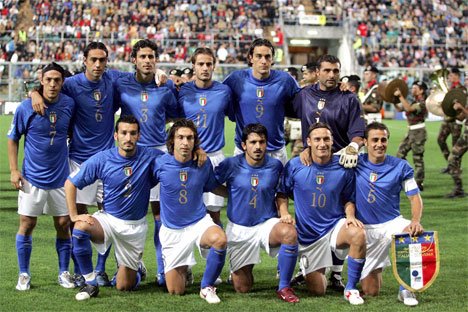
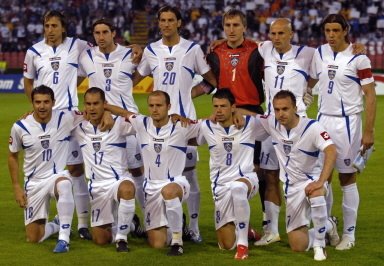
Serbia & Montenegro, as Srdjan puts it, represents the hopes of the countries that are not there anymore. Italy represents the hope of the countries that are looking for a fresh start: A Renaissance.

Wednesday, June 07, 2006

Serbia and Montenegro: beware of the country that no longer exists


Serbia and Montenegro will still participate as a single state at the upcoming football World Cup in Germany 2006. Serbia and Montenegro has a solid team that ended up first in the qualifications round (in front of Spain). It is important to point out that they conceded only one goal in the entire process of qualifications. Moreover, for the first time in the last 20 years the coach of the ‘national’ team was successful in creating a magnificent team spirit among the players. Despite the fact that Serbia and Montenegro is playing in the so-called “death group” together with Argentina, Holland, Ivory Coast and despite the fact that bookies consider it a total outsider, the chances of this team are great.

Only once in its history Serbia and Montenegro(then Kingdom of Yugoslavia, comprising todays's independent states of Slovenia, Croatia, Bosnia, Macedonia) ended up in the World Cup semi finals (in the very first world cup held in Uruguay 1930). This time this is likely to happen. If not for the statistics and bookies previsions then for the shere fact of the romantics. The triumph of the paradox can take place in Germany. Can you imagine a non-existent country playing in the World Cup finals and possibly winning the Cup? If your team did not qualify, or if you do not have preference in terms of the national selection you would like to support, then you have an appealing option, support Serbia and Montenegro (support Yugoslavia), the country that no longer exists.

Tuesday, June 06, 2006

France and Germany: waiting for Europe

Chirac and Merkl met today to discuss about the future of Europe (laughter). France and Germany would like to re-launch the constitutional process (laughter). This is not the Comedy of Errors, it's the tragic reality facing Europe.

As long as there are leaders like Chirac around, there is little to be hoped for Europe. Chirac was the major loser of the French Referendum on the European Constitution last year? Why is he still there? What does he have to say about Europe?

Even for someone who teaches and follows European law and politics, it is hard to claim that Europe is well and alive. We need a more drastic European discourse, and new faces to represent it.

The next European Council will gather on 15 and 16 of June. Will it be able to raise its voice?

Monday, June 05, 2006

Constitutional Dilemmas

Law is meant to solve conflicts between competing claims. Constitutional Rights are normally considered to be a very efficient tool to achieve that aim.

What if, however, constitutional rights conflict one against another and it is impossible to compare their strength, or to rank them?

This is the object of my forthcoming book with OUP titled Constitutional Dilemmas. Conflict of Fundamental Legal Rights in Europe and the USA. You can learn more about it here

Saturday, June 03, 2006

The Rhetorical Steps to War (4)

Tony Blair is seeking the benediction of Benedict.

What for? 'In Mr Blair's last papal audience on the eve of the invasion of Iraq, he explained to the late Pope John Paul II the reasons why he thought a military attack on Saddam Hussein would be morally justified.'

Are we on the eve of the invasion of Iran? The parallel is there for everyone to see and assess. I am only drawing your attention to this fact.

Thursday, June 01, 2006

Interviews for the Italian Radio

Recently I gave two interviews for the Italian radio Nova on the question of Ratko Mladic, indicted for war crimes in the ICTY and on the question of independence of Motenegro. Both interviews can be downloaded from the internet. The interview on Mladic, under the title “Radio Senza Frontiere_puntata n. 9” (click on parte2) and the interview on Montenegro under the title, “Nuovi confini nei Balcani: il referendum del 21 maggio visto dal Montenegro e dalla Serbia”.

Wednesday, May 31, 2006

Is independence referendum legitimate?


The results of the Montenegrin referendum were confirmed today and became official, thus, the republic became independent and the process of separation of the State Union of Serbia and Montenegro became official.

Independence of Montenegro, inevitable nourishes independence aspirations of other territorial entities across Europe and the World. The representatives of the Basque and Catalan territorial autonomies closely followed the Montenegrin referendum and the political climate evolving around this important event. Kosovo Albanians are hopeful that the independence of Montenegro will facilitate their speedy separation from Serbia and the Bosnian Serbs claim that they have right to vote on the future of the state of Bosnia and Herzegovina.

International law has very little to say on the legitimacy of a particular independence referendum, while constitutional orders of only few countries of the world consider secession a constitutional option.

The international community considers the independence of Kosovo a legitimate option while it has a diverse opinion in the case of the Serbian entity in Bosnia-Republic of Srpska. Looking at the legal arguments strictly speaking none of the two have the right to secede. Kosovo was an autonomous province of Serbia in the constitutional order of the Socialist Federative Republic of Yugoslavia, and as such it did not have the right to secede. Such right belonged only to the Republics. The arguments that Kosovo was de facto granted a status of the republic with the right of veto in the executive body of the ex-Yugoslavia, remains weak in this context. In the case of Bosnia and Herzegovina, the legal argument is similar. However, why is the constitutional order of a undemocratic communist state as the ex-Yugoslavia was, considered as a legal precedent in this case? Could the after Dayton territorial delimitation of Bosnia become legitimate over the passage of time in such a way as to allow the independence referendum for the Bosnian Serbs and Croats? Not now, but in 20 years time, when the current constitutional order of Bosnia becomes not only a legal but also a social and political fact. All these are questions that will be on the top of the political agenda in these countries for the years to come. Independence of Montenegro, whether one wants to admit it or not, will certainly have implications on the case of Kosovo and possibly Bosnia. Montenegro’s independence still found grounds in the legal system of the state of ex-Yugoslavia. In Kosovo, this is clearly not the case. Granting Kosovo independence without the consent of Serbia will be crossing of the Rubicon, and no one could stop the Bosnian Serbs (and Croats) to dissolve the state of Bosnia and Herzegovina. The independence of Montenegro, finally completed the series of legal sucessions of the ex-Yugoslav republics. Going beyond it would mean creating a precedentand a wholy novel legal practice, appealing to many independence movements around the world.

Italian politics: I can't stand it anymore

As many times said before, Berlusconism (Mr B. philosophy) is coming to an end.
On sunday, his party lost the administrative elections by far. He thought he would come back immediately, but the truth is that he's burnt for ever.

Italy is slowly putting itself together after a very distressful period, even if a major constitutional referendum is coming up on June 13. Tha will be the last event of an electoral saga that has shown to the entire world how frustrating can be italian politics.

Tuesday, May 30, 2006

Fallaci's Fallacious Ideas

Oriana Fallaci, an italian journalist living in New York, gave yet another aggressive interview published on the New Yorker.

Originally from Florence, she claims that she'll explode the mosque being built in Colle val d'Elsa, a small town beside Florence. Here's the relevant part:

"She spoke of a new mosque and Islamic center planned for Colle di Val d’Elsa, near Siena. She vowed that it would not remain standing. “If I’m alive, I will go to my friends in Carrara—you know, where there is the marble. They are all anarchists. With them, I take the explosives. I make you juuump in the air. I blow it up! With the anarchists of Carrara. I do not want to see this mosque—it’s very near my house in Tuscany. I do not want to see a twenty-four-metre minaret in the landscape of Giotto. When I cannot even wear a cross or carry a Bible in their country! So I BLOW IT UP!"

I think that it is a very distasteful choice on the part of the New Yorker to let Fallaci speaks as she does. After all, her opinion is not well informed and she is nothing more than a very opinionated journalist. Arguably, she is a famous and courageous journalist, but this does not make her opinion valuable. Also, she was admired in the past as she dreaded power and in particular the personification of power. Noble concern. But yet again, when you demolish power, you still have to put in place something that fills the gaps. A more illuminated authority, or something else. Fallaci fills the gap with unreasoned hatred.

The only reason why it is worth to publish an interview with Fallaci is that her outrageous opinions always increase the number of sells. So, well done New Yorker, you have indeed increased your popularity by selling crap.

Unfortunately, her thin arguments, based on thin air and pure gut (as she says herself), show precisely the lack of ability to communicate deeper and more articulate concerns on the place of religions within our public spheres.

But more importantly, building a mosque is about liberty (religious liberty in this case). Fallaci enjoys the liberty to speak freely, but she would like to restrain the liberty of some other people to practice their own religion. Arguably, she want to restrain only Muslim's freedom.

Why? Just because of hatred and nothing more... or so it seems. Just read the following citation from the New Yorker:

"The magnificently rebellious Oriana Fallaci now cultivates, it seems, the prejudices of the petite bourgeoisie. She is opposed to abortion, unless she “were raped and made pregnant by a bin Laden or a Zarqawi.” She is fiercely opposed to gay marriage (“In the same way that the Muslims would like us all to become Muslims, they would like us all to become homosexuals”), and suspicious of immigration in general. The demonstrations by immigrants in the United States these past few months “disgust” her, especially when protesters displayed the Mexican flag. “I don’t love the Mexicans,” Fallaci said, invoking her nasty treatment at the hands of Mexican police in 1968. “If you hold a gun and say, ‘Choose who is worse between the Muslims and the Mexicans,’ I have a moment of hesitation. Then I choose the Muslims, because they have broken my balls.” "

Is it worth to read the whole interview? I REALLY DO NOT THINK SO! It would simply increase the number of visitors of the New Yorker website. But you would not learn anything in particular, if not that it is possible to hate on a grand scale. My first gut reaction to her interview was to hope that someone blow her up, just as she would like to do with the mosque in Colle Val d'Elsa. After all, we all have gut reactions, and that is good. What is horrendous is to pretend that gut reactions are the way forward, a sort of illuminating solution to all the evils in the world.

Hatred, whatever its source, is only a source of evil. Let us simply hope that by airing it publicly it will be dispersed as any bad seed. If it were to germoliate, that would be sad, as sad as Oriana Fallaci

The US as "Failed State"

A quick link to an interesting article by Chomsky in todays Independent, an excerpt from (yet another) new book. In many ways, it is fairly standard Chomsky polemic, provocative and one-sided, and covering such a wide array of topics and incidents to make it practically impossible to summarise, or, indeed, engage with in any sustained critical manner. This is emphatically not to say, however, that Chomsky's writings in this regard are worthless; on the contrary, they perform an essential balancing role. It is, however, to my mind important to recall that things are rarely as black and white as he presents them (or that, even if they are in the final instance, his manner of presentation is unlikely to do more than preach to the converted).

Several interesting passages, however, including on the surprising reulsts of the US attempts to introduce democratic elections in Iraq and in Palestine, and also in terms of the Cuban role in the aftermath of the earthquake in Pakistan in 2005, and the role of Venezuela in rejuvenating the economies and politics of Latin America. Also noteworthy is his main claim, that the US displays the three basic characteristics of a 'failed state': unwillingness to protect their citizens from violence; a tendency to regard itself as 'above the law'; and a lack of democracy, either in terms of the basic institutional forms, or of a deficit between the output of those forms and the will of the general public. It is in the last point that Chomsky makes his most forceful argument of a striking incongruity between public opinion and public policy in the US, with many crucially important Government actions apparently standing in stark contradiction to what the majority of citizens actually want.

Like I said, pretty standard Chomsky; and this alone means that it's very much worth a read...

More Fragmentation of International Law? ECJ rules out Irish claim before ITLOS

The ECJ has today ruled that an attempt by the Irish Government to bring the UK before the International Tribunal for the Law of the Sea (ITLOS) over the Sellafield nuclear plant is in breach of EU law, on the grounds that only the Union institutions have jurisdiction of such claims between its Members. The Court has apparently held that, as the UN Convention on the Law of the Sea (UNCLOS) has been incorporated into EU law, the Irish action before ITLOS - which focuses on the Mox plant, designed to import and reprocess foreign waste - is illegal, as it fails to respect the its own exclusive jurisdiction over the case.

This was not unexpected. The Arbitral Tribunal set up to hear the Mox case noted as early as 2003 (see its Order No. 3 here) that it could not proceed with an examination of the merits until the question of exclusive EU competence had been decided; and it seemed entirely prepared to leave this decision to the ECJ (see para. 26). Even though neither the UK nor Ireland had argued before it that all interpretation of the Convention falls entirely under the exclusive jurisdiction of the ECJ, the Tribunal found that "it cannot be held with certainty that this view would be rejected by the European Court of Justice" (para. 21); and both parties were in agreement that, should this happen, then the Arbitral Tribunal set up under the UNCLOS would have no jurisdiction to hear the case.

The judgment is not yet available online, and it will certainly be necessary to read it closely before drawing any hard conclusions from it. It does, however, seem significant in more general terms, for those (such as, for example, the International Law Commission) concerned with the fragmentation of international law, and in particular with the fragmentation of those judicial bodies competent to rule on it. It is clear that this ECJ judgment paves the way for the possibility that the same Convention may well be subjected to final and binding interpretations by two different bodies, with potentially differing views, depending on which states are parties to any given dispute. It is thus easily conceivable that the same words of a legal instrument could give rise to two substantively different sets of obligations, depending on not what, but who is at issue. It is difficult to see, in these terms, how this decision of the ECJ can do anything but undermine the push towards the creation and enforcement of coherent and consistent global standards; and this in perhaps one of the most important areas of this endeavour, the responsibility for transboundary nuclear pollution.

Monday, May 29, 2006

29 May: the failure of the European Constitution

Today 29th of May is the anniversary of the failure of the European Constitution. One year ago, France voted No to the referendum and triggered a European crisis of 'consitutional' dimensions.

The real patient is not Europe as a supranational entity. Nation States are the ones in the worst state of health. Starting from France and ending with Britain.

France is the most obvious example. The referendum merely catalysed the downfall. Chirac and the right wing have gone through a very troubled period (suburbs, students, clearstream etc..). What is surprising is the fact that the left wing is unable to profit out of that failure. The reason is that the left wing who voted No to the European Constitution committed suicide.

They thought they were smart. The reality is that they do not have a clue of what to put in place of what they criticised. This is a gigantic sin. By giving up a hope of institutional improvement (not massive, though improvement), they legitimazed the status quo.

They probably did not know how horrible is the status quo. France as a nation state is dying and it prepares itself to die in the most spectacular way. Just as it did in 1789.

Saturday, May 27, 2006

The Rhetorical Steps to War (3)

Proposition 1: Blair and Bush acknwoledge mistakes in Iraq
Translation: Blair and Bush are now experienced war-mongers and they will prove so in Iran

Proposition 2: Tony Blair signal need for stronger UN!
Translation: Tony Blair wants the power to act pre-emptively

Friday, May 26, 2006

Neverending tension in Italy

Elections are bad for a country. This is the superficial message that one could gather by observing Italy at this very moment. On Sunday, 20 millions people will vote for the administrative elections. The cities of Milan and Naples are the most prestigious posts on offer.

But the problem is that the nasty climate of the political elections has been extended thus far, making it unbearable. A very good illustration of the less-than-civilized climate is given by the Bindi's case.

A (fascist) senator thought it appropriate to label a new minister as 'a lesbian.' His party members had to apologize on his behalf; his party leader called him 'imbecile.'

Where are we going?

Wednesday, May 24, 2006

Iran seeks US talks: The Rhetorical Steps to War? (2)

It seems that I may have underestimated the significance of the Iranian President's recent open letter to the Whitehouse. Until very recently, any contact at all with the US was viewed as taboo by the hardliners in the government, and the provocative, even at times offensive tone and content of the letter is perhaps best understood as an attempt to soften the blow domestically rather than increase it internationally. It seems to have worked: a number of leading conservative figures in Iran have publically endorsed the letter.

Now it has been followed, according to the Washington Post, by a request by the Iranian government for direct talks with their US counterparts over their nuclear programme; one European diplomat is even quoted as saying the Iranians are "desperate" to get around the negotiating table with "the Great Satan". This is clearly a significant ratcheting down of the level of rhetoric that we have seen before, and makes it appear that those analysts who insisted that the content of the letter was less significant than its return address were, in fact, correct: it now seems like it was an opening invitation to treat, regardless of how it was phrased.

So what has caused this volte-face? The Post suggests that it is fear of sanctions, coupled with strong Iranian public support for re-establishing some form of contact with the US. However, given the public stances of both Russia and China on the issue, official Security Council action seems some way off. Indeed, this move comes shortly after the Russian President Putin made his remarkable attack on the US, likening it to a "wolf" that simply "eats and listens to no-one"; and the Independent is today reporting Russia's increasing displeasure at US plans to build a range of bases in Europe to protect the West against any Iranian nuclear attack. Developments such as these seem to make concerted UN Security Council action much less likely; so why is Iran choosing now to make such, if not actaully conciliatory then at least potentially so, moves.

An unpleasant thought, certainly from the perspective of an international rule of law: is it less the immediate threat of sanctions, and more the knowledge of what the US is prepared to do if it can't bend the Security Council to its will? The Iranians may well come to feel that the checks and balances of the UN, however imperfect, are infinitely preferable to what the US has already shown it feels to be the only alternative to a paralysed Security Council.

Monday, May 22, 2006

Literary Suggestion

Just bought Philip Roth's last book 'Everyman', and quite excited about it.
Roth is the best writer alive, and captures as nobody else can the tragedy of life and death in our contemporary world (America in his case).

Sophocles and Shakespear are two other examples of that ability to grasp sublime tragic moments.

For a very recent review, please have a look at the New York review of Books, here.

Friday, May 19, 2006

Committee Against Torture on US Report

The UN Committee Against Torture has released its response to the US report filed under Art. 19 of the Torture Convention. It can be read in full here or see the BBC's summary here. A couple of interesting points:

- At para. 7, under the heading of "positive aspects", the Committee "notes with satisfaction the State party's statement that the United States does not transfer persons to countries where it believes it is 'more likely than not' that they will be tortured". This does not seem to set the evidential threshold for the non-refoulement clause of Art. 3 particularly high, and certainly lower than the "substantial grounds for believing"that there is a danger of torture if returned, which is the actual wording of the text. (On this point further, see the Committee's General Comment 1, in which it notes that the risk must go beyond the level of theory or mere suspicion, but that it "does not have to meet the test of being highly probable").

- At para. 13 - the Committee reiterates the need for a federal statute outlawing torture, despite the US's claims that all of its obligations to criminalise conduct under the Convention are already met by existing federal and state statutes. It also regrets that "despite the occurence of cases of extraterritorial torture of detainees" no prosecutions have been initiated under the extraterritorial criminal torture statute.

- At para. 14 - the Committee rejects the assertion by the US that the Torture Convention is not applicable in times of war, and that the "law of armed conflict" exclusively prevails. Only really surprising thing here is that this was even suggested.

- At para. 15 - the phrase "territory under the State party's jurisdiction" includes those areas over which they exercise de facto control; again, not particularly surprising, and the US Courts seem to be moving in this direction in terms of Guantanamo.

- At para. 17 - the Committee "regrets" the US response of "no comment" to the allegations of secret detention facilities in which detainees are subjected to cruel, inhuman and degrading treatment. All acts acts of intelligence gathering also engage the full international responsibility of the state.

- At paras. 20 and 21 - concern is expressed here about the fact that the US does not view the prohibition of refoulement as applying to detainees outside of its territory; perhaps most interesting here, however, is the recommendation on diplomatic assurances: "the State party should only rely on "diplomatic assurances" in regard to states which do not systematically violate the Convention's provisions, and after a thorough examination of the merits of each individual case". This may well be important in the context of the upcoming case in the UK, which I discussed here.

- At para. 22 - The Committee calls explicitly for the closure of Guantanamo Bay.

- At para. 24 - clarification (for those who needed it) that "water-boarding", "short shackling", sexual humiliation and the like are indeed forms of cruel, inhuman and degrading punishment, and hence outlawed under the Convention.

- At para. 40 - The Committee here invites the US to reconsider its decision not to become a party to the ICC.

These are, to my eye, the interesting international law-related passages. There are of course, many others, such as condemning the use of torture in Iraq and Afghanistan, calling for proper education and training of military and law-enforcement personnel, treatment of women and children, and calls to reconsider the certain devices and methods of execution. In terms of the last of these, what is perhaps most striking is that the Committee calls only for a reconsideration of the methods, and not the fact itself, of execution.

EU Parliament on "Human Rights in the World 2005"

Interesting just to note that the European Parliament's recent annual report on human rights, authored by the British Labour MEP Richard Howitt, has criticised the UK government for its failure to sign up to certain basic international human rights instruments; including the Migrant Workers' Convention and, perhaps more surprisingly, the Council of Europe's anti-trafficking convention and the Protocol to the Convention on the Rights of the Child on the involvement of Children in armed conflict. There is some praise to, however, for the UK's stance on the death penalty during the period of its Presidency.

The report suggests "EU activities in the UN with respect to human rights are too introverted" (para. 27), regretting in particular the Union's failure to sponsor resolutions condemning human rights violations in China, Chechnya and Zimbabwe; further, in a section (para. 23) that seems particularly loaded in the light of the Mohammed cartoon controversy, the Parliament

Specifically reminds the Council and the Commission that most human rights abuses would be impossible in countries with stronger traditions of freedom of speech and press freedom; therefore calls on the Council and the Commission to emphasise this key point as strongly as possible in all political dialogues, as in the case of development and trade policy.

On the subject of the ICC (para. 32), the Parliament has some reasonably strong words for the US: it

Calls on the US Administration and the Congress to end the delay and ratify the Rome Statute establishing the ICC; considers that no legal exception can be made for the United States on this point; condemns the fact that certain countries, including a number of EU Member States, have entered into "bilateral agreements" with the United States granting de facto impunity to US soldiers.

Another interesting element is the relatively tame level of rhetoric reserved for Iran (para. 37), despite the dismissal by the latter of the EU's latest compromise proposals as like offering "walnuts and chocolates" to a four-year-old child. The Parliament responds by condemning

... the Iranian President's call for Israel to be wiped off the map; expresses its concerns about the human rights situation in Iran and... expresses its regret at Iran's poor human rights record during the first six months of President Mahmoud Ahmadinejad's term of office...

Also noteworthy is their concern that current migration measures within the EU do not in practice allow for its international obligations in terms of refugee law to be met (para. 98). That's my impression of the most interesting bits, after, admittedly, a very quick skim. There's probably other stuff in there, but it is, after all, only the Parliament speaking; they do, at least, have the good grace to concede that their own interventions in terms of human rights "could be rendered more effective in a number of ways"...

Thursday, May 18, 2006

The Journal of Philosophy of International Law

For all those interested in Law and Politics in International law and beyond,
here's a new journal published online: The Journal of Philosophy of International Law.

The editor in chief is my colleague at Aberdeen Law School, Prof. Tony Carty. . This is an electronic journal, only accessible on the web. I particularly welcome the growth of e-journals as they allow a more speedy diffusion of ideas and spare the costs of printing. After all, all we should care about is the quality of scholarship. The quicklier it gets circulated, the better.

On the eve of the Montenegrin Referendum: explaining the ambiguities


1. The grey zone: The European Union imposed a condition on the Montenegrin referendum procedure. Namely, in order for the independence vote to be successful 55% of those who vote will have to support this option. If the independence vote ends up being between 50% and 55%, Montenegro could legally not become independent but the factual situation will be such that more people voted for independence than for the joint state. Montenegrin government was not happy about this condition but was forced to accept it. The argument for imposing such qualified majority requirement was partially based on comparative legislature, partially on the conviction that deciding on the independence of a certain territory or administrative unit will have to be based on the support of the largest possible portion of the population in order to assure a stable and united future for the country, in both cases. Such condition, imposed by the EU, proved to be the right one, also because it managed to make all political options participate in the referendum procedure. Why is then the Djukanovic’s government insisting on the political construction of the grey zone? In this way Djukanovic is creating himself more space for political manoeuvring. He is threatening to severe Montenegro’s relations with Serbia and withdraw all Montenegrin political appointments and administrative staff from federal institutions. Simply, the Montenegrin government could continue to behave as if Montenegro were independent and ignore EU’s demands for the construction of a more functional federal state. This is, however, less likely. The grey zone is an escape goat for Djukanovic, in this way he has some chance of presenting himself as a winner in the referendum, at least until the September parliamentary elections. Winning less than 50% would mean an end of the political career of Milo Djukanovic, last of the old ex-Yugoslav, ex-Communist nomenclature.

2. High voter turnout: The higher the voter turnout, the more difficult will it be for Montenegro to go independent. Paradoxically, strong campaigning for independence will cause more people to vote regardless of their preference in terms of the future of the Montenegrin state. On the other hand, Djukanovic could not allow himself not to campaign. There were rumours (and some vide footage) that the government is temporarily buying off the identity cards from the members of the unionist block in order to prevent them from voting and in order to decrease the voter turnout, but it is rather uncertain that this illegal practices could have an important impact on the final exit of the vote. This time, there is a greatest number of registered voters in the democratic history of Montenegro. This is not a good sign for Djukanovic. Few will decide to do something else on the day of the elections, if the voter turnout reaches what now seems the impossible 90%, everything can happen. In this case even the impossible scenario in which the independence vote would remain below 50% remains an option.

3. We love you but we want to leave and be the masters of our own destiny: This is the winning formula for the Montenegrin independence and the Djukanovic’s political block is strongly using this political rhetoric. Namely, the vast majority of the Montenegrin population feels strongly related to Serbia and their common Serbian culture. Many Montenegrin citizens live and work in Serbia or have close business ties with Serbia. On the other hand, the bad memory of Milosevic’s years, the impression that the union with Serbia carried in itself a heavy price of the years of isolation, bad economic situation etc., makes many more prone to vote for independence. Yet, the fear of the severing of the relations between the two states in the case of Montenegrin independence might just make them opt for the joint state. It is for this reason that the tones in the independence campaign lately became more moderate, “we will go independence but everything will remain the same”, “when Montenegro becomes independent first foreign capital that I would visit would be Belgrade, said a Montenegrin foreign affairs minister”. Will everything remain the same? Probably yes, but people wonder. The fact that Djukanovic often used radical political rhetoric to support the independence option certainly did not help his cause.

4. Bosniak voters: Seemingly, the Bosniak Muslim population living in Montenegro will vote for independence. Djukanovic’s regime was always more tolerant towards minorities than Milosevic’s. While the Albanian minority in Montenegro will surely vote for independence, this is not so certain in the case of the Bosniaks. Bosniak political parties participating in the government at the national and local level in Serbia were actively involved in the campaign for the joint state and this can have an important political impact on the result of the Montenegrin referendum. Namely, the area in which the Bosniaks live, Sandzak, lies in the south-west of Serbia and in the north of Montenegro, splitting this region in two in the case of Montenegrin independence would certainly not favour the local business and personal relations (this is especially true in the case of initial cold inter-state relations between Serbia and Montenegro.

Wednesday, May 17, 2006

Prodi presents his team today

The italian executive does not start very well.
The number of ministers has increased, which means a lowered accountability.
The number of women is not very significative (only 25%)
The nature of the executive is highly political and biased toward radical left
rather than a more reformist left.

Reforms are the daily bread Italy is craving at the moment, so let's hope that this team will be able todeliver on so many crucial political points.

Montenegro: The myth of ethnic differences

Reading the European and North American Press these days one gets the impression that there is a Montenegrin majority and Serbian minority in Montenegro. For example, Nicholas Wood from International Herald Tribune Tuesday 16th May 2006 argues, “Diplomats worry that any attempt by Montenegro to declare independence unilaterally could provoke the region's Serbian minority, about 30 percent of Montenegro's population of 650,000.”

In this way foreign correspondents fall into the trap of perceiving the political division in Montenegro as ethnic division. Historically, Montenegro existed as a State independent from Serbia but the population of this geographical area always perceived itself belonging to the greater core of the Serbian nation. Prince Danilo Petrovic Njegos (1852-1860), Montenegrin XIX century ruler, proscribed in the Code of Prince Danilo, article 92, “Although there is no other nationality in this land except Serb nationality and no other religion except Eastern Orthodoxy, each foreigner and each person of different faith can live here and enjoy the same freedom and the same domestic right as Montenegrin or Highlander.” Thus, belonging to the Serb cultural space and nation did not exclude regional identification of these people as Montenegrins. The course of history from XIX century onwards created a situation in which political in fights and divisions led to the gradual creation of a Montenegrin identity, considered by many separate from the Serbian identity. Communist dictatorship after 1945 through the formalization of the status of Montenegro as a Republic contributed to the creation of the mirage of ethnic difference.

It is by all means true that political differences today, contribute to the slow but gradual reification of ethnic differences. Today, many hard line supporters of Montenegro’s independence consider themselves Montenegrin, not Serbian. Nevertheless, this process is by all means not irreversible and could, if and when the political tensions die out, turn back to a more or less calm setting. Political identification with the independence agenda is one thing, family relations are other. There are numerous families in Montenegro divided along the disagreement of the future status of Montenegro.

The latest census is indicative of a change in the declaration of ethnic affiliation of the inhabitants of Montenegro, compared with that made at the 1991 census. This applies particularly to Montenegrins and Serbs. The number of those declaring themselves as Montenegrins decreased from 380,000 in 1991 to 273,000 in 2003, while the number of declared Serbs from 57,000 to 202,000. The declared composition of the total population is as follows: Montenegrins 40.6%, Serbs 30%, Bosniacs and Muslims 13.7%, Albanians 7.1%, Croats 1% and Romanies 1.2%. Ethnic affiliation was not declared by 4.3% of inhabitants and that of 1.6% of inhabitants is not known. The increased number of citizens declaring themselves as Serbs does not reflect their sudden relinquishing of the Montenegrin identity. Rather, these people, 30% of Montenegro, understood that identification as Montenegrins amounts to the support of the independence agenda, and decided to underline the Serbian part of Montenegrin identity. On the other hand, many of the 40.6% of citizens declaring themselves as ethnic Montenegrins belong to the Serbian Orthodox Church and most of them do not negate the Serbian component of the Montenegrin national identity.

True, the present referendum campaign, on both sides has done much to increase the false impression of strong ethnic differences that are surely confusing to the average foreign reader.

Tuesday, May 16, 2006

Slovenia will soon join the EURO zone

This is a very welcome news. It is a sign of growing economic integration and the recognition of the great efforts and successes of Slovenia, one of Italy's neighbours.

In a period where political integration is trying to find a direction, economic integration may bear more fruits than expected. Of course, there is no ground for being overly optimistic, but it is still an important development.

I only hope that Slovenia can learn from the mistakes of other countries (e.g. Italy) when shifting to Euros. The local government must make sure that the transitional period is as transparent as possible and that no sudden inflation of prices takes place because of that.

Monday, May 15, 2006

Washington and Tripoli - An Old Relationship Rekindled

The United States recalled Libya from its diplomatic doghouse today, restoring full diplomatic relations and removing it from the State Department’s list of state sponsors of terrorism. In explaining the move, Secretary of State Condoleeza Rice said, “We are taking these actions in recognition of Libya's continued commitment to its renunciation of terrorism and the excellent cooperation Libya has provided to the United States and other members of the international community in response to common global threats faced by the civilized world since September 11, 2001.” This seems to be in line with the strain of the Bush administration’s realist philosophy that advocates a foreign policy of punishing intractability but rewarding responsiveness. Indeed, Libya has become something of a reformed sinner by U.S. reckoning, swearing off nuclear weapons and providing information on its former terrorism activities. However, Moammar Gadhafi’s government is anything but a model international citizen, having, in recent years, been implicated in an assassination plot against then Saudi Crown Prince Abdullah, (almost certainly) falsely imprisoning Bulgarian and Palestinian health workers to cover the government's own gross incompetence that led to the infection of hundreds of Libyans with the AIDS virus, and other inexcusable conduct. Critics of the U.S. move are already howling about oil-driven diplomacy. No doubt, this is a consideration for U.S. policymakers, who are eager to see American companies take advantage of Libya’s largely untapped energy resources and are under pressure from American consumers to lower energy prices. They are also increasingly worried about competition for ever scarcer energy from China. Another source of oil, especially in a relatively accessible locale like Libya, is a boon. However, it seems likely they resumed relations with Libya on the basis of a more complex cost-benefit analysis. First, American conservatives sincerely believe in a realist diplomacy that rewards good behavior by reforming countries as an incentive for other delinquents to do the same. Second, the Bush administration, and the American policy community at large, is, not unreasonably, obsessed with the Muslim world. They constitute, after all, roughly a quarter of the world’s population. Adding a Muslim ally, even a stinker like Libya (especially one with lots of oil), is good policy in their calculation. Finally, surely the Bushies tire of being angry with so many governments all the time. Iran, Syria, North Korea, France, Spain, Bolivia, Cuba....Even they, it would seem, feel the need to kiss and make up every now and then.

CALCIO under arrest

After the bitter-(sweet) elections, after the elections of the President of the Republic, after the capture of Provenzano (Mafia Boss par excellence), I thought that we had enough troubles and tensions in Italy to fill any possible emotional hole.

Wrong! Even football, the beloved national sport, is under fire and this time it promises to be a scandal of dynosaur proportions. Read here.

What next? You can start from anywhere you want... Perhaps, Universities? Corruption is endemic and pervades everywhere.

Prodi, not yet the official Prime Minister, will have to deal with a very tricky situation. Nearly everything has to be constructed from scratch. This may be good, but it will take an effort of Herculean proportions!